Nexus for quality offices
Preparing Accreditation Visits and Regulator Returns with Nexus
Regulator returns and accreditation visits eat months of a quality office's year. Nexus builds them from records the university already keeps, and shows the gaps while there is time to fix them.
Why returns and visits take months
Every year a quality office gathers the same facts again: how many professors and lecturers, how many hold a PhD, the full-time equivalent of each rank, the laboratories and lecture rooms, the library holdings and the publications. The facts live in personnel files, estates spreadsheets and departmental lists. Someone types them into the regulator's form, a deputy checks the totals, and errors still slip through.
Accreditation visits are harder still. A panel arrives with an instrument of many items, each needing evidence, and the university discovers in the final weeks which evidence it does not have.
Oxonia Nexus is the regulator and quality product in Oxonia Lead. It turns both jobs from a yearly scramble into a view that is always up to date.
Start with staff records you can rely on
Most of what a regulator asks about is staff. Nexus keeps each staff member's record, appointments, rank and full-time equivalent in one place, so the numbers in a return come from the same records that HR uses.
Records can be imported in bulk: upload a CSV or Excel file, map the columns, validate with a preview, download the errors, review suggested duplicates and commit. Rows with errors are never imported and nothing is written until someone commits.
Staff publications can be brought in from each person's ORCID record and confirmed by the staff member. See ORCID and research output reporting.
The annual return fills itself
When a new annual return is started, Nexus fills it from the records:
- Staff: for each academic rank, from Professor to Graduate Assistant, the headcount, the number holding a PhD and the full-time equivalent, from current appointments of active staff.
- Facilities: laboratories, workshops and lecture rooms, items of equipment, print library titles and current e-resources and subscriptions.
- Research: confirmed publications.
Each value remembers that it was filled automatically, so if someone changes it the difference is visible. The return layout is set up to your regulator's own form. Until a regulator's official form is loaded, Nexus uses a demonstration layout that is clearly labelled as such.
The point is not only speed. When the same records feed the return every year, the figures are consistent from one year to the next, and a change in a figure means something changed in the university, not that a different person counted it in a different way.
| Section | Rows | Counted from |
|---|---|---|
| Staff | Headcount, PhD holders and FTE for each of seven ranks | Current appointments of active staff |
| Facilities | Labs, workshops, lecture rooms, equipment | Active asset records |
| Library | Print titles, current e-resources | Library holdings |
| Research | Publications | Confirmed publications |
Checks before anyone signs
Before a return can be signed, Nexus checks it. The checks look for internal consistency, agreement with the platform's own records, unusual change from last year, and outliers against peers, using only aggregate figures from at least five institutions.
Every flag explains itself, in plain words, so the quality office knows what to look at. Errors must be fixed. Warnings must be fixed or explained. The thresholds are settings that decide what a person should look at; they are not regulatory rules, and the university can answer any flag in its own words.
The result is a return that the Vice-Chancellor can sign knowing that someone has looked at everything unusual.
Signed by the Vice-Chancellor, then locked
The return is signed by the Vice-Chancellor or their designate. At that moment Nexus locks it: it records who signed and when, and stores a SHA-256 fingerprint of the return's contents. After submission the database refuses any change, so the return that was signed is the return that was sent.
Where the regulator also uses Oxonia, it can accept the return or send it back with a note. Where the university has switched regulator oversight on, every time the regulator looks inside the university is written to the university's own audit log.
Signing is deliberately the last step. A return cannot be signed while any error is open, or while any warning has neither been fixed nor explained. The Vice-Chancellor signs knowing that the checks have been worked through, and the audit log records each step, from the first automatic fill to the final signature.
Accreditation readiness for every programme
Nexus shows live readiness for each programme against the accreditation instrument. Items with an automatic rule are scored from a platform figure, using the bands stored on the instrument itself. Other items use the university's own self-score, which needs evidence. Every gap comes with the fastest action to fix it.
The self-study builder creates one section per instrument section, plus an overview, pre-filled with facts from the platform. People write the narrative, or approve a draft from the self-study drafter.
Evidence is treated carefully. A photo taken with the in-app camera on campus, within the campus boundary and with a correct clock, is signed and marked as verified evidence. Anything else is kept but labelled as an unverified upload, with the reason.
Panel visits, and where to start
For visits, Nexus helps plan the panel. Appointing an evaluator checks for conflicts of interest against their declared affiliations and any role they hold at the university, then gives them access to that visit only, for its time window. Each panel member gets a visit pack with the programme, instrument items with guidance, the self-study, the evidence checklist and the staff list, kept encrypted for use offline. Panel scores and reports are gathered in one place.
Start with staff records, because they feed both the return and readiness. Then load one programme's evidence a term ahead of its visit. Read the background in accreditation readiness and regulator returns.
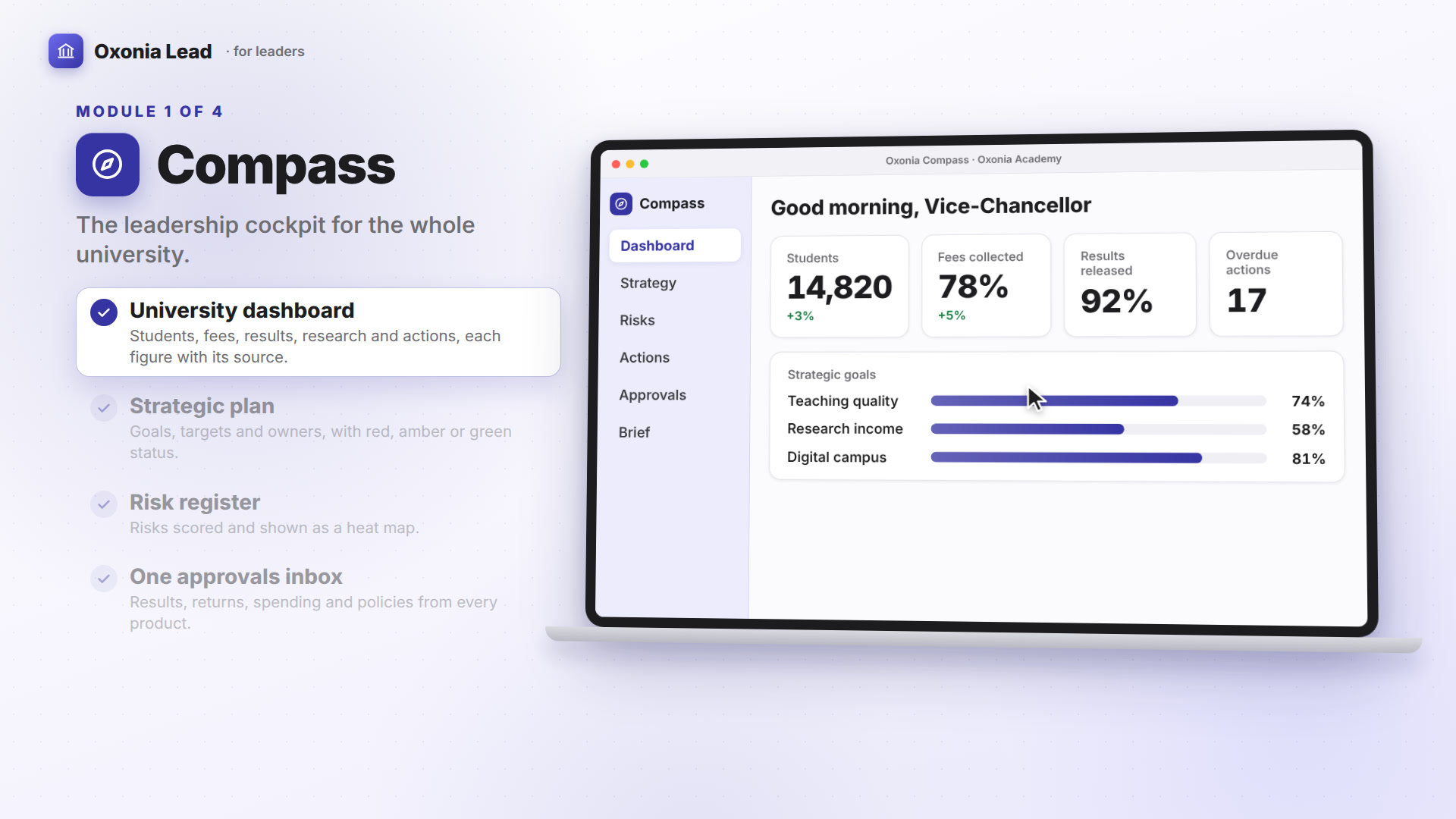
Quality offices that use Nexus well tend to keep readiness visible all year rather than only before a visit. A short review each term of the gaps on each programme, and the fastest fix for each, keeps the work small and steady. Leaders can see the same picture, and items waiting for them in Nexus also appear in the approvals inbox in Compass.
Products in this article
Questions people ask
Does Nexus include the official NUC return form?
Nexus is set up to your regulator's own form. Until the official form is loaded, a clearly labelled demonstration layout is used.
Can a return be changed after the VC signs it?
No. Signing stores a fingerprint of the return and the database refuses changes after submission.
How is accreditation readiness worked out?
Some items are scored from platform figures; others use the university's self-score with evidence. Every gap shows the fastest fix.
Can panel members work offline during a visit?
Yes. Each panel member's visit pack is kept encrypted for offline use.
Leaflets


More videos
 0:54Conference film · Chapter 9Time, money and income
 1:40Suite filmOxonia Lead in 100 seconds
 1:54Conference film · Chapter 4Lead: Senate, Compass, Office, Policy, Library
Keep reading
Related articles
Oxonia Lead →
For the Vice-Chancellor, Deputy VCs, Deans and Directors: a strategic plan built with the whole university and checked against the budget, policy and governance, a budget the Ai helps allocate, and benchmarking against peer universities.