Advance for the bursary
Student Fees, Scholarships and Alumni in One System
A student's relationship with the university's money starts with fees and, at best, ends with a gift as alumni. Advance handles the whole journey.
Two jobs that belong together
Most universities treat fees and alumni as separate worlds. The bursary collects fees. A small alumni office, often elsewhere, tries to keep in touch with graduates. Each has its own spreadsheet and its own contact list.
Yet they are two ends of the same relationship. A student who was helped through a hard year by a hardship award is more likely to give back later. A graduate who gives can fund the award that keeps the next student enrolled. Joining the two makes both stronger.
Advance is the product in Oxonia Operate that does both. The bursary and the alumni office share one system and one set of records, with access set by role.
Students, guardians and sponsors see their side of it through Wallet, the student fees app.
Fees, payment plans and receipts
Advance holds each student's fees account: charges, payments, scholarships and balances. Bursary staff issue bills to each account, or import them from a spreadsheet, and students see them in Wallet straight away.
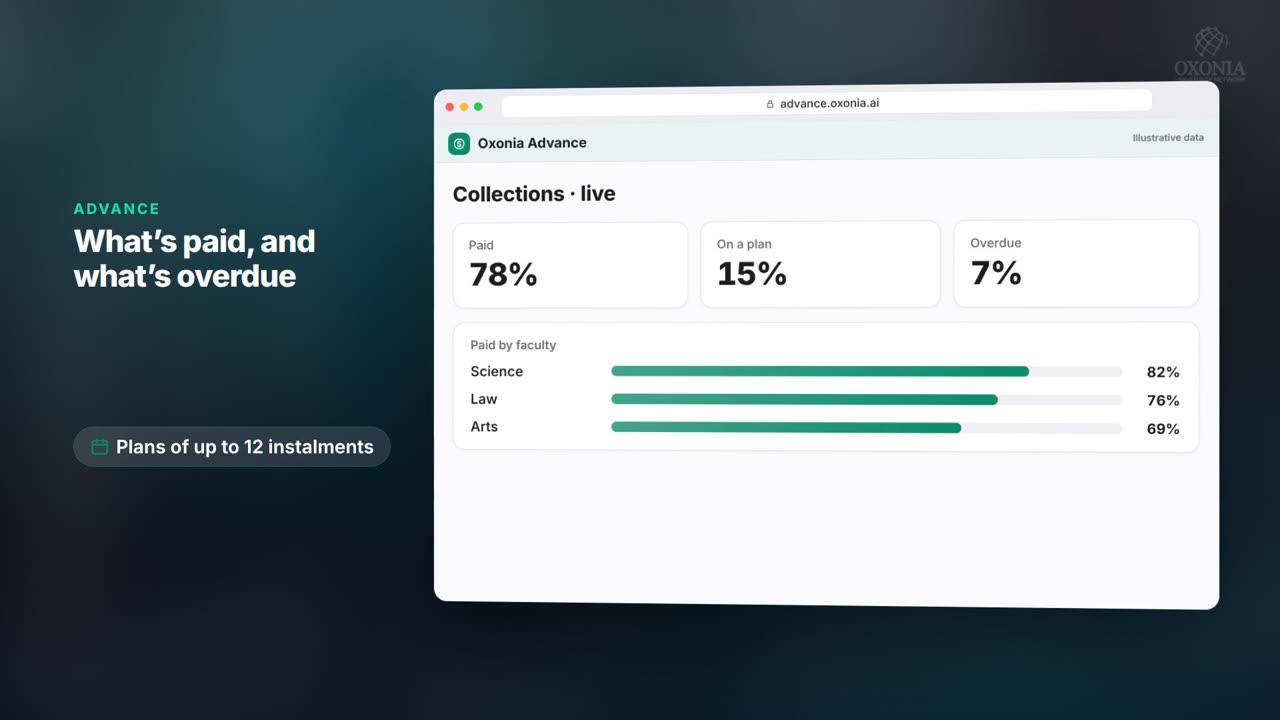
Payment plans let students spread fees across instalments. Bursary staff set up a plan of up to twelve instalments for a student, and the student sees it in Wallet. Advance tracks every instalment and shows staff who is behind. Every Monday it emails a reminder about any overdue balance to the student, guardians and sponsors.
Card payments in Wallet go through the university's own Paystack account, and the receipt is issued at once and emailed. Bank transfers reported in Wallet, and payments entered by other staff, wait for the Bursar to confirm them before a receipt is issued.
- Fees accounts for every student
- Payment plans with weekly reminders
- Card payments through Paystack, plus transfer, cash, POS and mobile money
- Numbered receipts for every confirmed payment
Guardians and sponsors, such as employers or public schemes, can be linked to a student's account. They see the same balance, plan and receipts in Wallet and receive the same reminders. That ends much of the common confusion about who has paid what.
Scholarships, hardship and retention risk
Students apply for scholarships and hardship support in Wallet, with a short statement and, if they choose, their household income. Staff can also enter an application for a student. The Bursar reviews each one and records the decision. A person decides every award.
Advance also matches retention risk. It looks for signs that a student may leave because of fees, such as missed instalments or a growing balance, and matches them with support they may be eligible for. Staff see the match and decide what to offer.
The risk score is not AI. It is worked out from the fee record only, and its reasons are shown next to it. It never makes an award or blocks a student on its own. Read more in keeping students who might leave over fees.
Decisions are recorded with reasons and the name of the person who made them. That keeps support fair and makes it easy to report on how hardship funds were used. Staff can see how much has been awarded against each fund, and how much remains for the rest of the year.
Alumni records and contact consent
Advance keeps the university's alumni records: name, email, programme, graduation year, employer and city. Staff add graduates one at a time or import an existing list from a spreadsheet, so the alumni office does not start from scratch.
Each record says whether the graduate has agreed to be contacted. Anyone who has not is clearly marked, so staff can respect that choice before an appeal goes out.
Staff can search the records by name, programme, employer or city. Each record shows how much that graduate has given and how many gifts, so the alumni office knows who has supported the university before.
Because the records sit beside the fee accounts, the bursary and the alumni office work from one system instead of two spreadsheets and two contact lists. That helps a small office focus its limited time where it has most effect.
Campaigns, gifts and fundraising
When the university raises funds, Advance keeps the campaign: its name, goal and dates. Staff record each gift as it arrives, by bank transfer, cash, POS, mobile money or cheque, and link it to the graduate who gave and the campaign it supports.
Each campaign shows how much has been raised against its goal. The most recent gifts appear in one list with the donor and the campaign, and every campaign and gift is written to the audit log.
Scholarship and hardship funds sit in the same product. When a campaign raises money for scholarships, the bursary sets up the fund and awards it to current students, so the university can tell donors whom their support reached.
This also helps retention. A student who stays because of a hardship award may be the graduate who gives back later, and Advance keeps both sides of that story in one place.
| Stage | What Advance handles |
|---|---|
| Applicant and new student | Fees account, payment plan, scholarship applications |
| Student | Payments, receipts, hardship support, retention risk |
| Graduate | Alumni record with contact consent |
| Established alumni | Gifts, giving history, fundraising campaigns |
What leaders see
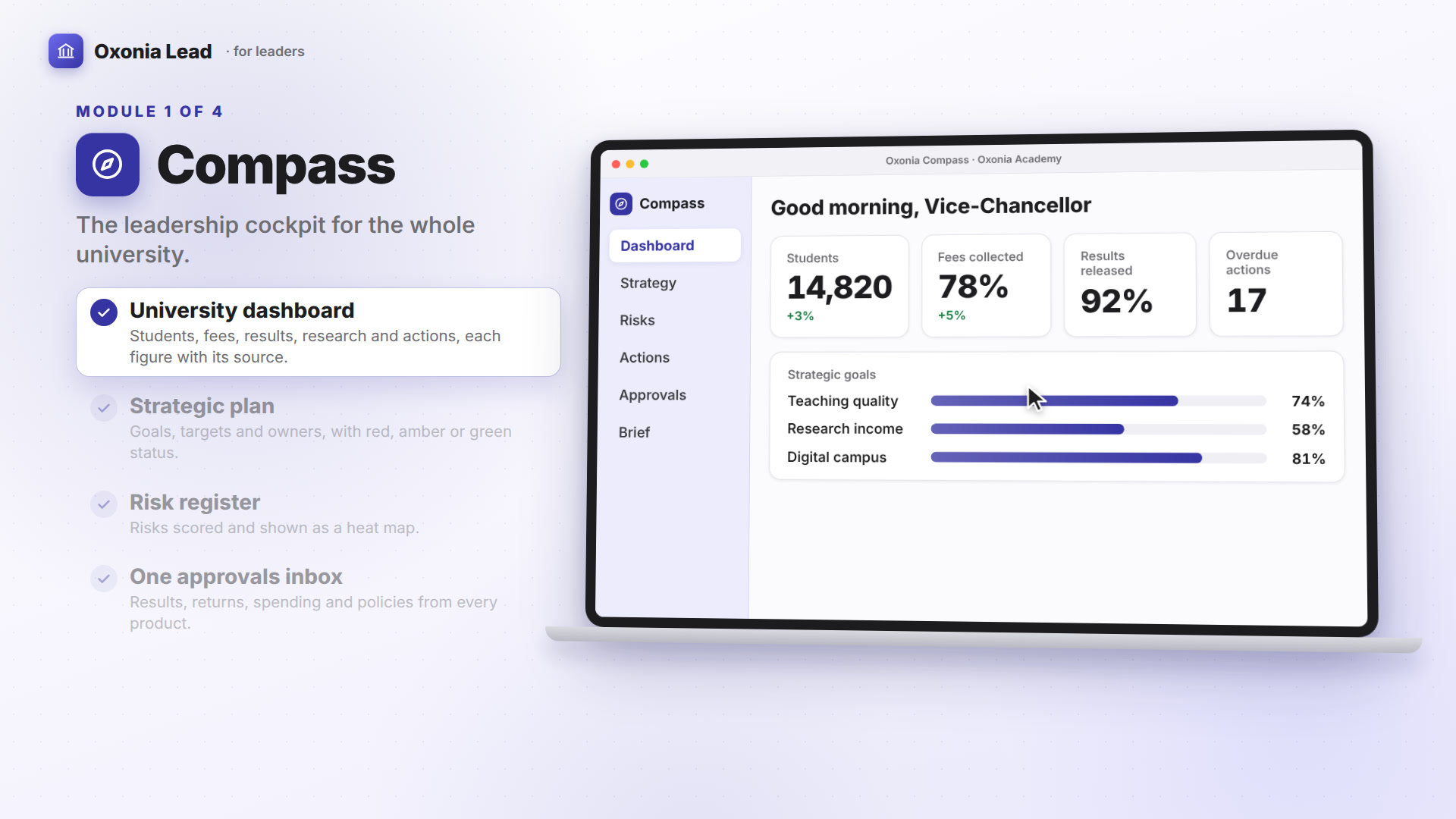
Fee collection, payment plan status and retention risk appear in Compass. The Bursar and the vice-chancellor can see how collection is going this week, not at the end of the term.
Advance's own leadership view adds fundraising: the total raised this year, how many alumni have given and each campaign's progress against its goal.
Because the figures come straight from Advance, they are always current. Leaders no longer have to wait for the bursary to compile a report, and bursary staff no longer need to compile one. Each figure links back to the records behind it.
Price and how to start
Advance costs £16,000 a year for up to 5,000 students, £25,000 for 5,000 to 15,000 and £36,000 for 15,000 to 40,000. Wallet comes with Advance. Universities in Nigeria pay 35% of the UK price, billed in naira.
Advance is part of Oxonia Operate, which costs £34,400 a year for a mid-size university. See pricing or read about the Operate suite.
Many universities start with fees and Wallet at the start of an academic year, then bring in their alumni records and start a first campaign once the fees side is running.
Products in this article
Questions people ask
What does Advance do?
Advance runs student fees, payment plans, receipts, scholarships, hardship support and retention risk, plus alumni records, fundraising campaigns and gifts.
Is Wallet included with Advance?
Yes. Wallet, the app for students, guardians and sponsors, comes with Advance.
Does Advance support Paystack?
Yes. Card payments in Wallet go through the university's own Paystack account. Bank transfer, cash, POS and mobile money payments are recorded too, and the Bursar confirms them.
How much does Advance cost?
Advance costs £16,000 a year for up to 5,000 students, £25,000 for 5,000 to 15,000 and £36,000 for 15,000 to 40,000.
Leaflets


More videos
 1:11Conference film · Chapter 5Operate: records, Advance and Wallet
 1:40Suite filmOxonia Lead in 100 seconds
 1:54Conference film · Chapter 4Lead: Senate, Compass, Office, Policy, Library
Keep reading
Related articles
Oxonia Operate →
For the Registry, Admissions, Finance, Student Services and departmental administrators: meetings, approvals and memos automated, applications screened against your criteria, and answers for students and staff at any hour.