Policy for leaders
University AI Policy: Build, Approve, Train and Report
An AI policy that sits in a drawer protects nobody. Policy turns it into rules people can find, training they can prove and records regulators can check.
The AI question every university faces
Students and staff already use AI tools. Some uses help learning and research. Others put academic integrity, personal data or the university's reputation at risk. Leaders know they need rules. Regulators increasingly expect to see them.
Writing a policy is only the start. The policy must be approved properly. Staff need training. Students need to know what is allowed in each assessment. The university needs to know which tools are in use and what happens when something goes wrong.
Most universities try to do this with a document, a few workshops and a mailbox. It is hard to show what was done, and harder to keep it current.
Policy, part of Oxonia Lead, covers the full cycle. It is the governance side of AI, while AI Hub is the side students and staff use day to day.
Build the policy and approve it through Senate
Policy includes an AI policy builder. It takes the university through the key questions: assessment, research, teaching, administration, data protection and procurement. The builder produces a draft in the university's own words.
The draft is Ai enabled and only a draft. A named policy owner edits it. Then it goes to Senate for approval through Senate, with a one-page summary for members. Once Senate approves it, the policy is published and becomes the source for AI Hub's answers.
When the policy needs to change, the same route applies. Each version is kept, with the date and the meeting that approved it.
This gives the university a clear chain from decision to practice. Anyone can see which version applies and who approved it.
Register AI use and handle tool requests
Policy keeps an AI-use register. It lists the AI tools the university uses or allows, what each is for and who owns it. Staff can request a new tool through a simple form. The request goes to the right reviewer, and the decision is recorded.
The register answers questions that leaders and regulators often ask. Which tools do we use? Who approved them? What data do they touch? Without a register, the honest answer is often that nobody knows.
Universities can choose to use the platform's shared AI credit wallet or their own AI keys. Either way, the register records it.
Tool requests are also a chance to help staff. A lecturer who wants to use a new tool for teaching gets a clear answer with reasons, rather than silence or a blanket refusal. If the tool is approved, it joins the register with its conditions, and other staff can see that it is allowed.
Train staff and students, with proof
Policy includes AI literacy training with checkable certificates. Staff complete short modules and receive a certificate that can be checked later. Heads of department can see who has completed training. Students learn through the lessons in AI Hub.
For assessments, students complete AI-use declarations. Lecturers set what is allowed for each assessment, and declarations are stored with each submission.
- AI literacy training for staff with checkable certificates
- Lessons for students in AI Hub
- AI-use declarations for each assessment
- Ask-the-policy answers with clause citations
Training records matter when questions arise. If a member of staff used a tool in a way the policy forbids, the university can see whether they had completed training. That helps decide whether the answer is more training or a formal process.
| Record | Used by |
|---|---|
| Approved policy versions | Senate, staff, students, auditors |
| AI-use register and tool requests | IT, data protection, leaders |
| Training certificates | Heads of department, HR |
| AI-use declarations | Lecturers, exams office |
| Incidents | Policy owner, leaders |
| Regulator reports | Registrar, VC |
Readiness, incidents and the audit room
Leaders see a readiness score. It shows how far the university has come: policy approved, register in place, training completed, declarations in use. The score helps set priorities and report progress to Council.
When something goes wrong, staff record an incident. The incident is assigned, investigated and closed, with actions tracked. Patterns become visible over time.
The audit room gathers the evidence an auditor or regulator would ask for: approved policy versions, the register, training records, declarations and incidents. Policy also prepares regulator reports from the same records.
Incidents are not only about misconduct. They include a tool that gave wrong information to students, a data concern raised by a researcher or a gap the policy did not foresee. Recording them helps the university learn and improve the policy at its next review.
How Policy links to the rest of the platform
Policy feeds Compass, so AI readiness appears on the leadership dashboard and in the risk register if leaders choose. Policy approvals run through Senate. Students reach the approved policy through AI Hub in Oxonia Learn.
The same platform rules apply. Every Ai enabled answer cites its sources. People approve anything that becomes an official record. Read the wider picture in governing AI in universities.
Because the approved policy is the single source for AI Hub, students and staff always see the current rules. There is no risk of an old PDF circulating after Senate has changed a clause. When leaders report to Council, the readiness score and incident list come from the same records that staff use every day.
Price
Policy costs £9,500 a year for up to 5,000 students, £12,000 for 5,000 to 15,000 and £15,000 for 15,000 to 40,000. AI Hub comes with Policy. Policy is part of the Oxonia Lead package, which costs £52,000 a year for a mid-size university.
See pricing for package savings and 3-year discounts.
Most universities start by building and approving the policy in the first term, then rolling out training and declarations in the second. Testing the training and declarations with one faculty first is a good way to prepare for a university-wide launch.
Products in this article
Questions people ask
How do we write a university AI policy?
Policy's builder takes you through the key areas and produces a draft. A policy owner edits it and Senate approves it.
Can we prove staff have done AI training?
Yes. Policy includes AI literacy training with checkable certificates, and heads of department can see completion.
What is an AI-use register?
It lists the AI tools the university uses or allows, what each is for, who owns it and who approved it.
How much does Policy cost?
Policy costs £9,500 a year for up to 5,000 students, £12,000 for 5,000 to 15,000 and £15,000 for 15,000 to 40,000.
Leaflets


More videos
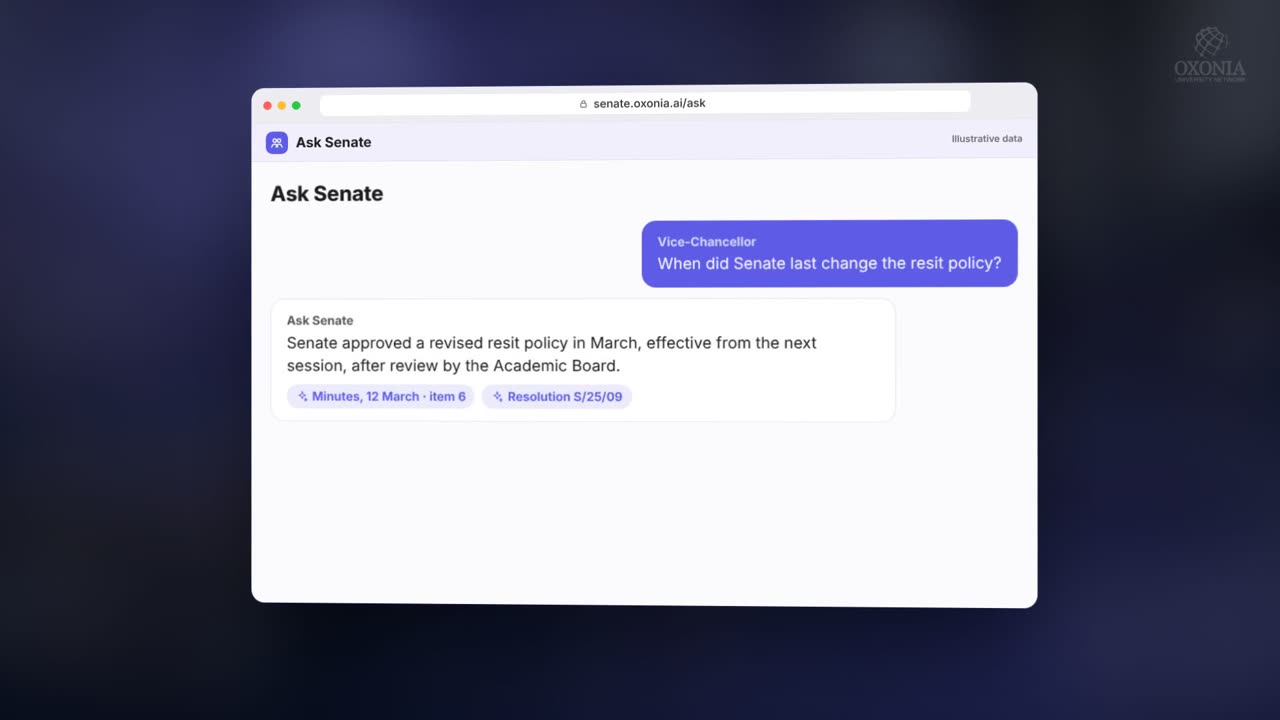 1:54Conference film · Chapter 4Lead: Senate, Compass, Office, Policy, Library
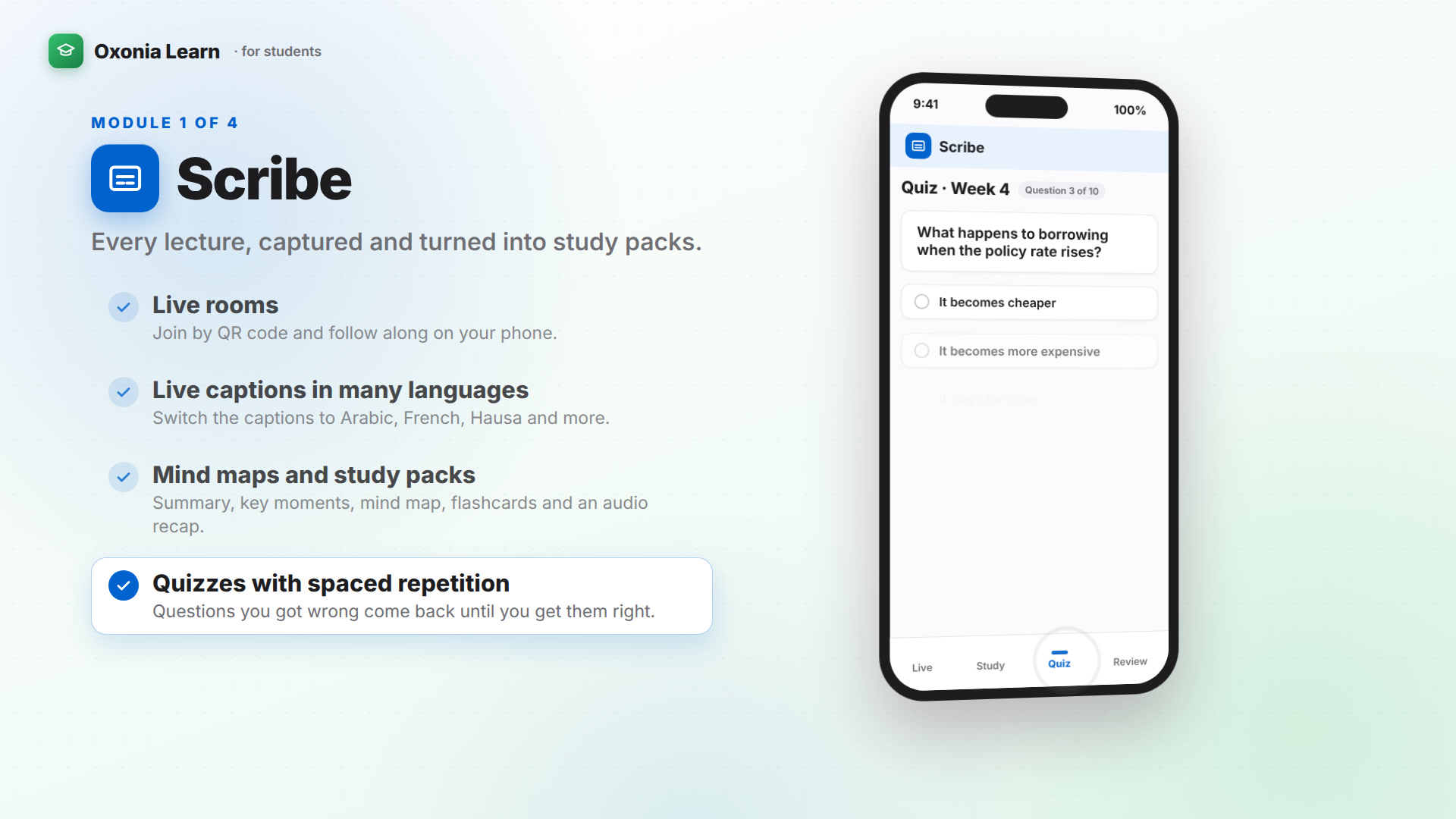 1:36Suite filmOxonia Learn in 100 seconds
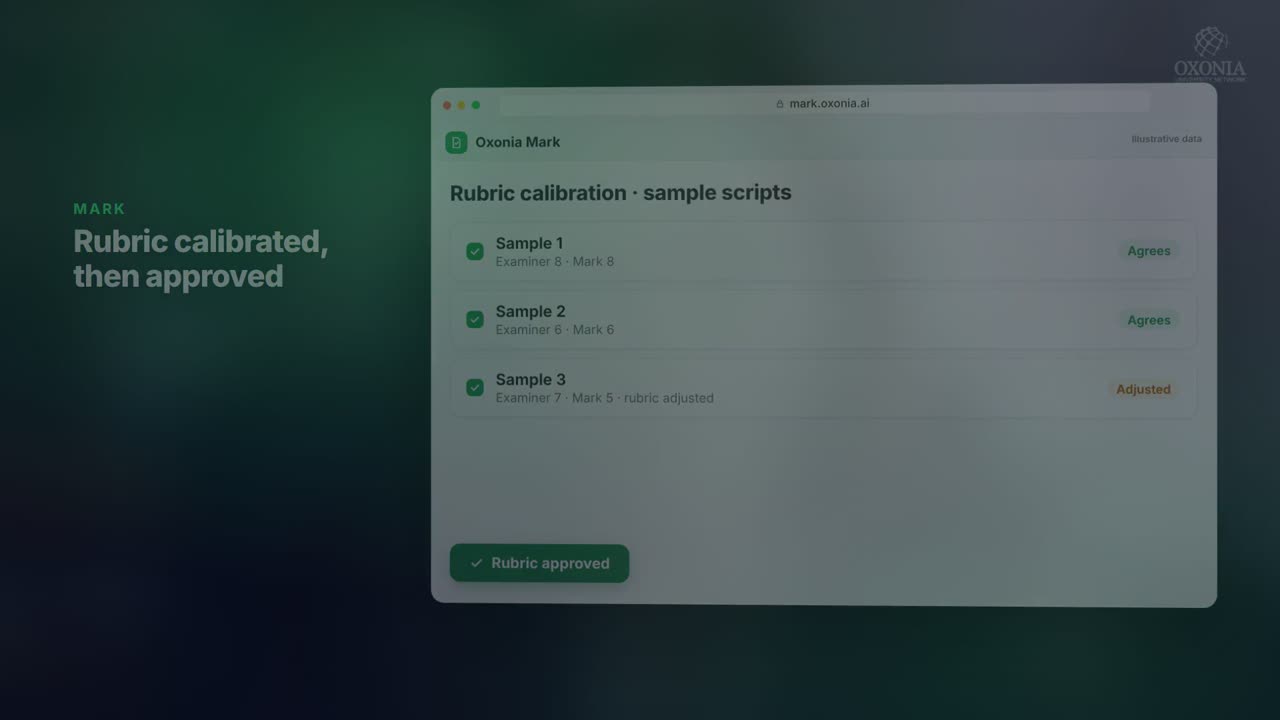 0:50Conference film · Chapter 7Learn: Mark
Keep reading
Related articles
Oxonia Lead →
For the Vice-Chancellor, Deputy VCs, Deans and Directors: a strategic plan built with the whole university and checked against the budget, policy and governance, a budget the Ai helps allocate, and benchmarking against peer universities.