Senate for governance
Council and Senate Meetings: Board Packs to Signed Minutes
Good governance depends on good papers, clear decisions and actions that get done. Senate handles all three, from the calendar to the signed minutes.
The governance load on a university
A university runs on meetings. Council, Senate, faculty boards, exam boards, finance committees, ethics committees and many more. Each needs a calendar, an agenda, papers, a quorum, decisions, minutes and follow-up. The secretariat carries most of that weight.
The work is often done with email, shared drives and printed packs. Papers arrive late and run to hundreds of pages. Members struggle to read them. Minutes take weeks to finish. Actions agreed at one meeting reappear, undone, at the next.
This is not a small problem. Governance failures in universities are often failures of follow-through. A risk was raised but nobody owned it. A decision was made but never recorded clearly. An action was agreed but nobody chased it.
Senate is the product in Oxonia Lead that runs this cycle. It works for Council, Senate and any committee the university sets up.
The aim is to give the secretariat its time back for the work that needs judgement, such as advising the chair and shaping the agenda, rather than formatting packs and chasing signatures.
Calendar, agendas and board packs
Senate starts with the governance calendar. The secretariat sets the year's meetings for each body. Paper deadlines follow automatically. Authors know when their paper is due and get reminders as the date approaches.
Agendas are built from the items submitted. The secretary orders them, adds standing items and publishes. Board packs are assembled from the papers, with page numbers and links, and sent to members in the Boardroom app.
Each paper gets a one-page summary. The summary is Ai enabled and cites the pages it draws on. It does not replace the paper. It helps a busy member see what the paper asks them to decide, and where to read closely.
- Governance calendar for every body
- Paper deadlines and reminders for authors
- Agendas and board packs built from submissions
- One-page summaries with page citations
The Boardroom app for members
Members use the Boardroom app to read papers, add private notes and see past decisions. They sign in with their Oxonia Academy ID. External members of Council get the same access, limited to the bodies they sit on.
The app keeps the full history of each body. A new member can read earlier minutes, the resolutions register and open actions. That helps them get up to speed quickly and ask better questions.
Members can read on a tablet or phone. They no longer need to carry printed packs or download large files before a meeting.
Secretaries can also send late papers or tabled items through the app, so members always work from the latest version. Older versions are kept, and the app shows clearly which paper was considered at the meeting.
Live quorum, voting and transcription
During the meeting, Senate tracks attendance and shows whether the meeting is quorate. If members leave and quorum is lost, the chair sees it at once. Votes can be held in the app, with results recorded against the item.
Senate can transcribe the meeting. The transcript stays with the secretary and supports accurate minutes. The university decides which meetings are transcribed and how long transcripts are kept.
Conflicts of interest can be recorded against items, so the record shows who stepped out of which discussion.
Chairs find the live view helpful. They can see which items remain, how long the meeting has run and which items need a formal vote. The secretary can note decisions as they happen, which makes the draft minutes more accurate.
Minutes drafted, approved and signed
After the meeting, Senate drafts the minutes from the agenda, the papers, the votes and the transcript. The draft follows the university's own style. It is a draft and nothing more.
The secretary edits the draft, checks it with the chair and approves it. Minutes are then signed electronically. Only approved and signed minutes become the official record. This follows the platform rule: people approve anything that becomes an official record.
Decisions go into the resolutions register. Agreed actions go into the actions register, with an owner and a due date for each one.
Action Chaser
Action Chaser sends reminders to action owners by email and WhatsApp. Owners can update progress from the message. The secretary sees which actions are on track, late or done, and can report this at the next meeting without asking around.
Overdue actions also appear in Compass, grouped by faculty, so leaders see where follow-through is slipping. Results packs from Mark can go straight onto a Senate agenda, and AI policy drafts from Policy are approved through Senate too.
Over time, the registers become a clear account of what each body decided and whether it happened. That is valuable for regulators, for auditors and for the university itself.
| Stage | What Senate does | Who decides |
|---|---|---|
| Before | Calendar, deadlines, agenda, board pack, one-page summaries | Secretary and chair |
| During | Quorum, voting, transcription, conflicts | Members |
| After | Draft minutes, e-signature, registers | Secretary and chair |
| Follow-up | Action Chaser by email and WhatsApp | Action owners |
Price and how to start
Senate costs £14,000 a year for up to 5,000 students, £19,000 for 5,000 to 15,000 and £24,000 for 15,000 to 40,000. Larger universities get a quote. Senate is part of Oxonia Lead, which costs £52,000 a year for a mid-size university and saves 20% on buying the products separately.
Many secretariats start with one committee for a term before moving Council and Senate across. See pricing or read about the Lead suite.
A sensible first step is the committee with the heaviest paper load or the longest list of open actions. Once the secretariat is comfortable, Council and Senate can follow at the start of the next governance year. Members need very little training, because the Boardroom app works like any reading app on a phone or tablet.
Products in this article
Questions people ask
Can Senate draft meeting minutes?
Yes. Senate drafts minutes from the agenda, papers, votes and transcript. The secretary approves them and they are signed electronically.
How does Action Chaser work?
Action Chaser sends reminders to action owners by email and WhatsApp and shows the secretary which actions are on track or late.
Does Senate show live quorum?
Yes. Senate tracks attendance and shows whether the meeting is quorate, and records votes against each item.
How much does Senate cost?
Senate costs £14,000 a year for up to 5,000 students, £19,000 for 5,000 to 15,000 and £24,000 for 15,000 to 40,000.
Leaflets


More videos
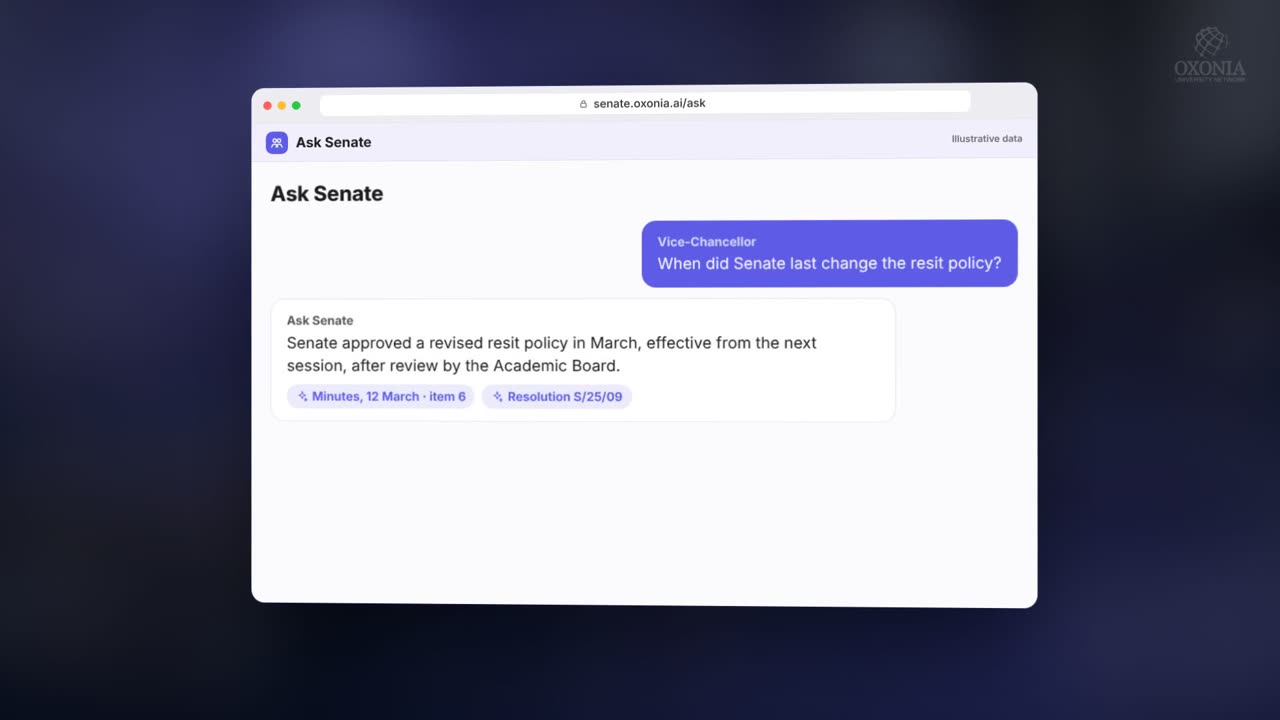 1:54Conference film · Chapter 4Lead: Senate, Compass, Office, Policy, Library
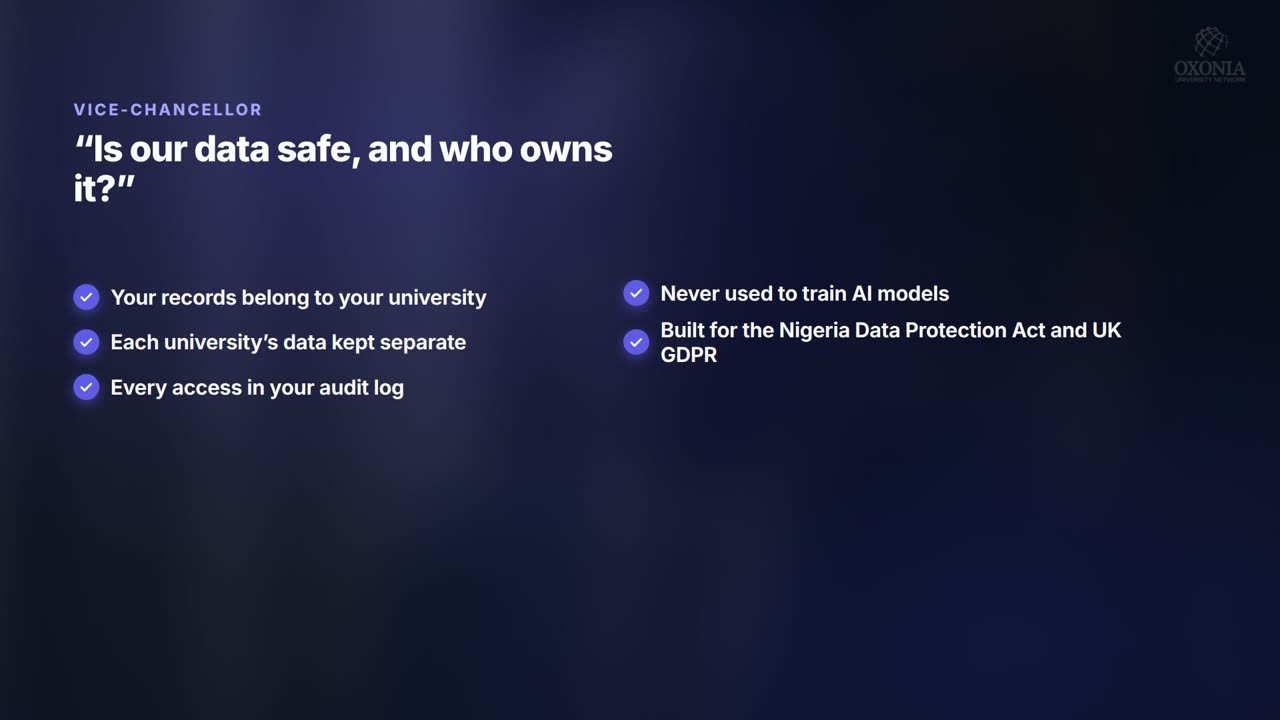 1:34Conference film · Chapter 10Your questions answered
 0:54Conference film · Chapter 9Time, money and income
Keep reading
Related articles
Oxonia Lead →
For the Vice-Chancellor, Deputy VCs, Deans and Directors: a strategic plan built with the whole university and checked against the budget, policy and governance, a budget the Ai helps allocate, and benchmarking against peer universities.