AI Hub for students
AI Literacy for Students and Staff, With Clear Rules
Students are already using AI. AI Hub teaches them to use it well and tells them, clause by clause, what your university allows.
Why students need more than a policy document
Most universities now have rules on AI use. Many publish them as a PDF on the website. Few students read it. Those who do often find it hard to apply to a real assignment. Can I use AI to check my grammar? To summarise a reading? To plan an essay?
Staff face the same uncertainty. One lecturer bans all AI use. Another encourages it. Students move between modules and get mixed messages. When a case of misuse comes up, it is hard to show the student was told the rules.
AI Hub closes that gap. It gives students and staff short lessons, clear answers to their own questions and a simple way to declare how they used AI in assessed work.
The goal is not to police students. It is to help them use AI in ways that support their learning and are honest about what they did. Most students want to follow the rules. They just need the rules to be clear, close at hand and the same from one module to the next.
AI literacy lessons
AI Hub includes AI literacy lessons for students and staff. Lessons cover what AI tools can and cannot do, how to check their output, how to avoid passing off generated text as your own and how to protect personal data. They are short and practical.
Staff can take AI literacy training with checkable certificates through Policy. A head of department can see who has completed the training. Students see their own progress.
Lessons can be offered in English, French, Arabic, Portuguese, Hausa, Yoruba, Igbo and Swahili, and AI Hub's screens can be used in English, French, Portuguese, Arabic, Hausa, Yoruba, Igbo and more.
Lessons use realistic examples from student life: drafting an essay plan, checking a translation, working through a statistics problem. Each one shows a good use and a poor use side by side, and explains why the difference matters for learning and for academic integrity.
Ask the policy, get the clause
Students and staff can ask questions about the university's AI policy in plain language. AI Hub answers from the approved policy and cites the clause. A student asking whether they can use AI to translate a source sees the answer and the exact clause it comes from.
This is an Ai enabled assistant with a narrow job. It answers from the policy that Senate approved, not from general opinion. If the policy does not cover a question, it says so and points the student to the right person.
- Plain-language questions, any time
- Answers drawn only from the approved policy
- Clause citation on every answer
- Clear signposting when the policy is silent
Questions and answers also show the university where its policy is unclear. If many students ask the same question and the answer is uncertain, the policy team can see it and propose a clearer clause at the next Senate review.
AI-use declarations for assessments
For each assessment, the lecturer sets what AI use is allowed. Students then complete an AI-use declaration when they submit. They say what tools they used and how. The declaration is stored with the submission.
Declarations protect students who follow the rules. They also give staff a clear record if questions arise. Markers using Mark can see the declaration beside the script. Integrity concerns still go to a person, and the university's normal procedure applies.
Lecturers choose from simple settings, such as no AI use, AI use for planning only, or AI use allowed with a full declaration. The setting is shown to students before they start, so nobody can be surprised by it later. Different modules can choose different settings, but each student always knows which applies.
| Group | What they get |
|---|---|
| Students | Lessons, policy answers with clause citations, AI-use declarations |
| Lecturers | Set allowed AI use per assessment, see declarations |
| Staff | AI literacy training with checkable certificates |
| Leaders | Readiness score and reports through Policy |
Where the policy comes from
AI Hub draws on the policy built in Policy, part of Oxonia Lead. Policy includes an AI policy builder. The draft goes through Senate for approval. Once approved, it becomes the source for AI Hub's answers.
Policy also keeps an AI-use register and handles tool requests, so staff can ask to use a new tool and get a recorded decision. Leaders see a readiness score, incidents and reports for regulators. Read more in our guide to governing AI in universities.
This connection matters. When Senate updates the policy, AI Hub answers change with it. Students and staff do not have to wait for a new PDF to be written and circulated. The latest approved version is always the one that answers.
How students reach AI Hub
Students reach AI Hub with their Oxonia Academy ID, from the same app launcher as their lectures in Scribe, tutorials in Tutor, results and fees. It is part of Oxonia Learn.
Because AI Hub sits next to the study tools, the rules are close at hand when students need them. A student starting a Tutor session can check what the course allows in a few seconds.
Staff reach AI Hub in the same way. A lecturer preparing an assessment can check the policy, set the allowed AI use and point students to the right lesson, all from one place.
Cost
AI Hub comes with Policy. Policy costs £9,500 a year for up to 5,000 students, £12,000 for 5,000 to 15,000 and £15,000 for 15,000 to 40,000. It is also included in the Oxonia Lead package, which costs £52,000 a year for a mid-size university.
See pricing for all options, including Department plans and Oxonia Complete.
Many universities start AI Hub with first-year students, who are forming their study habits. Others start with final-year students writing dissertations, where the stakes are highest. Both approaches work well as a first step.
Products in this article
Questions people ask
What is AI Hub?
AI Hub gives students and staff AI literacy lessons, answers about the university's AI policy with clause citations and AI-use declarations for assessments.
Where do AI Hub's policy answers come from?
Only from the AI policy approved by the university's Senate, with a citation to the clause.
Is AI Hub sold separately?
No. AI Hub comes with Policy, which starts at £9,500 a year for up to 5,000 students.
Leaflets


More videos
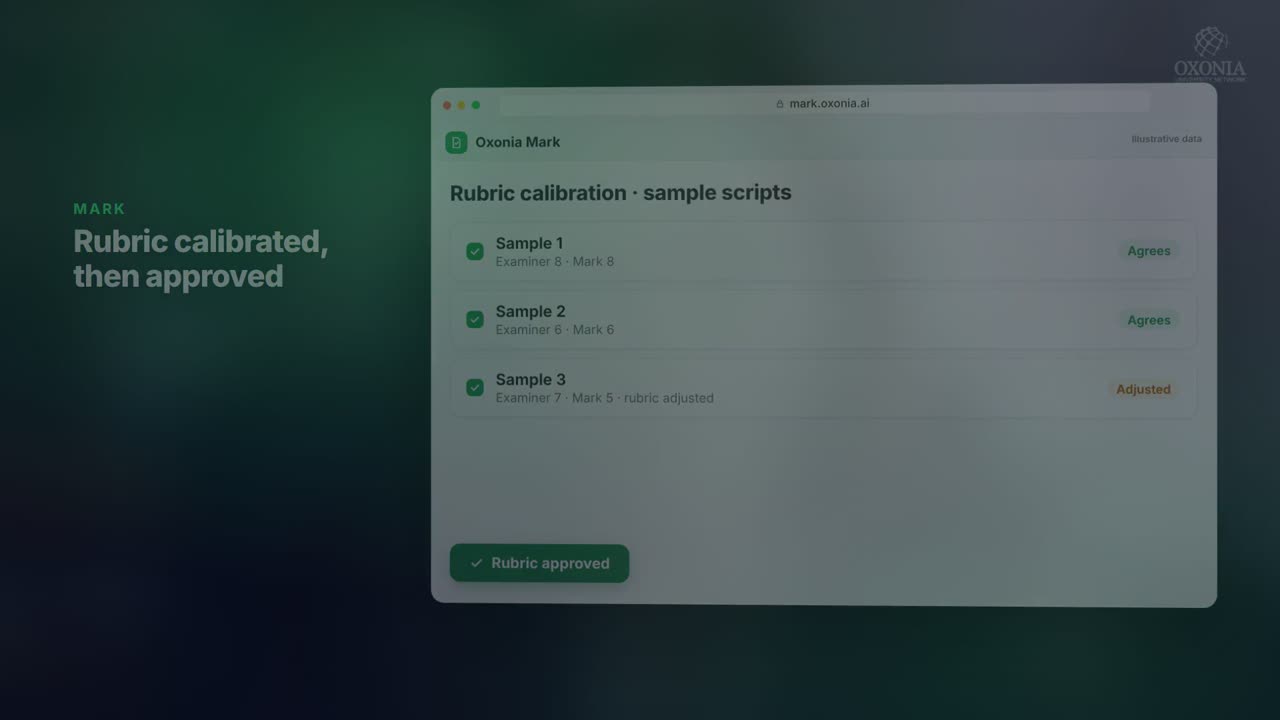 0:50Conference film · Chapter 7Learn: Mark
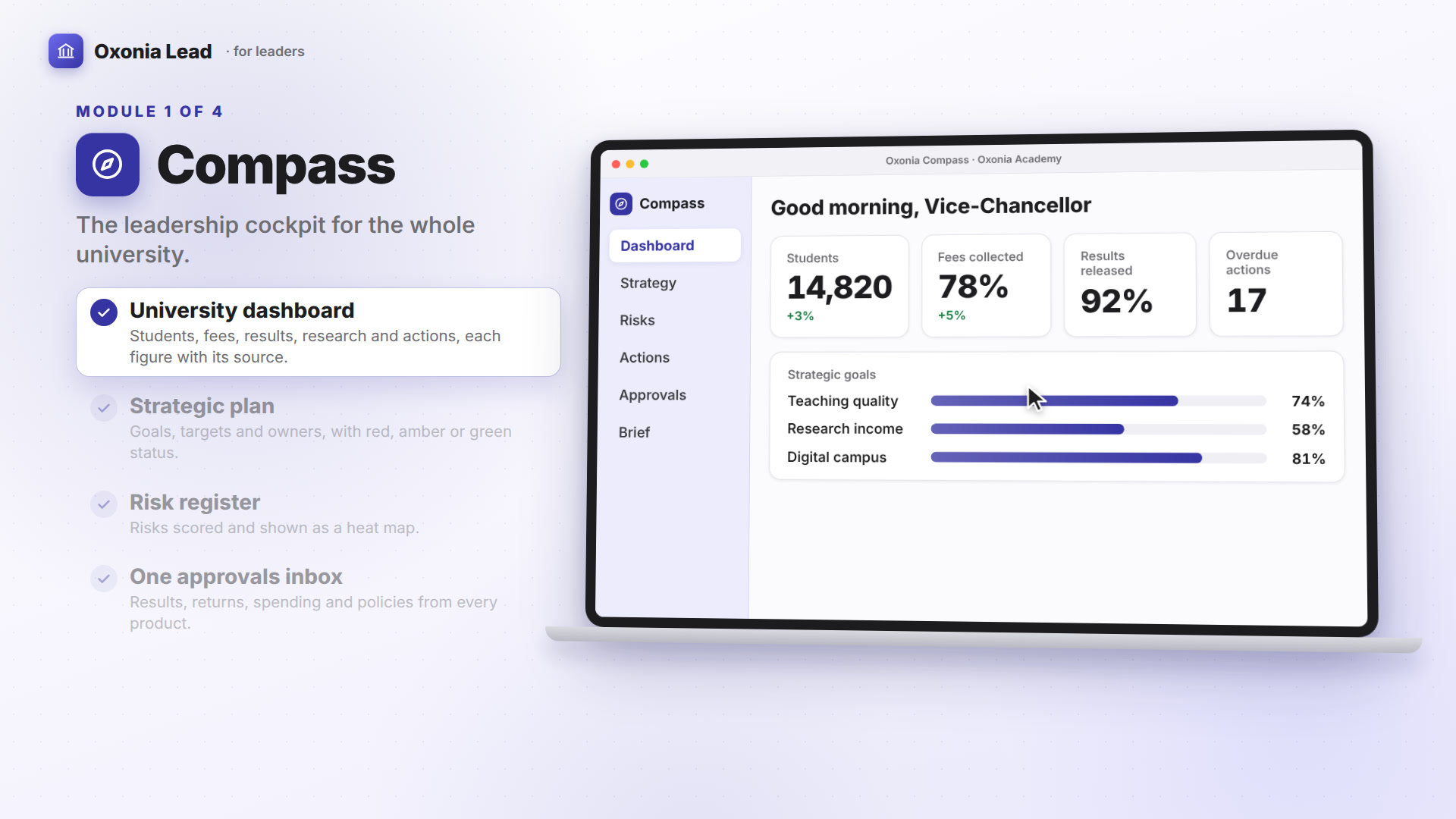 1:40Suite filmOxonia Lead in 100 seconds
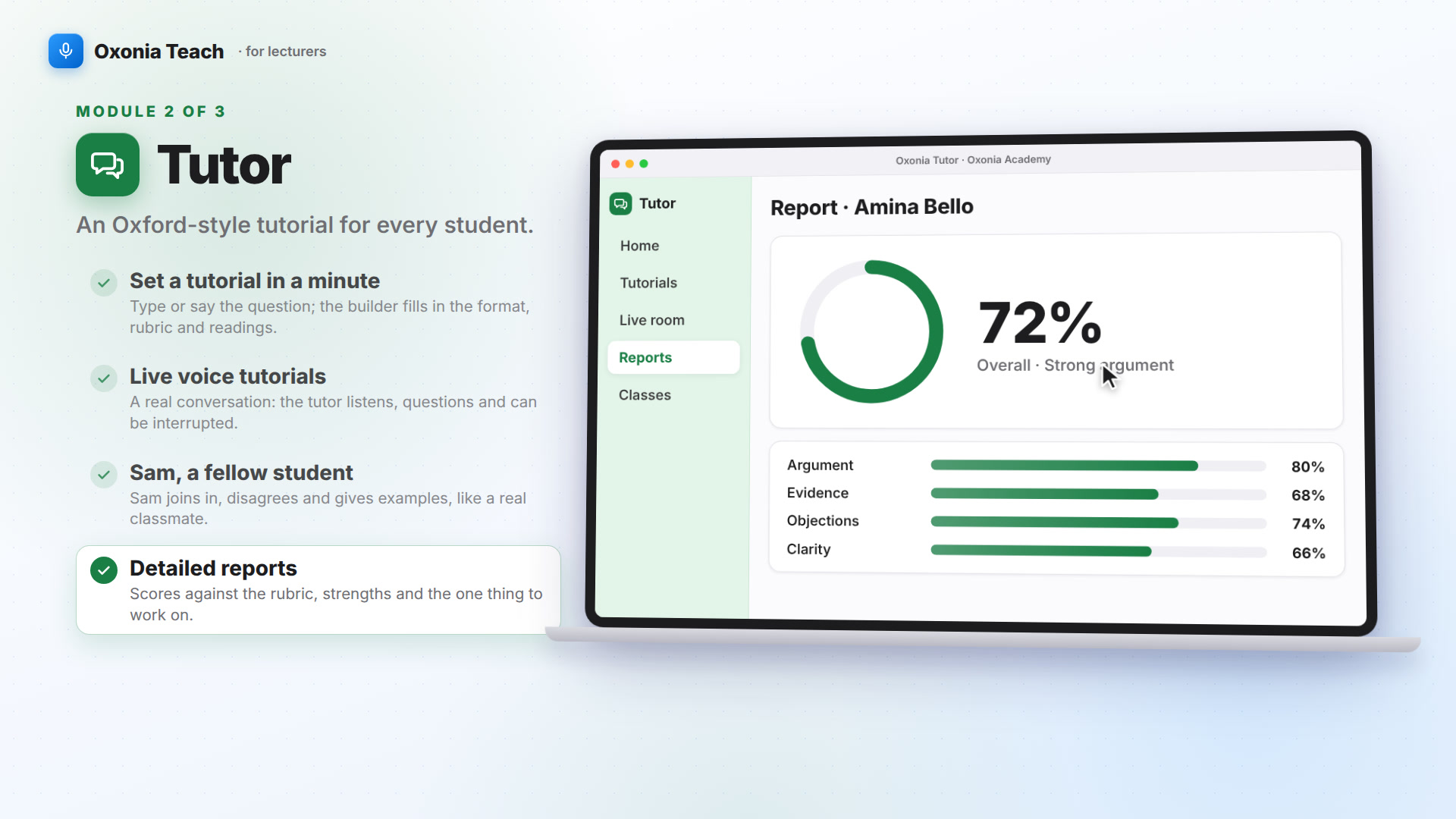 1:39Suite filmOxonia Teach in 100 seconds
Keep reading
Related articles
Oxonia Learn →
For undergraduate, postgraduate, international and doctoral students: a personal Ai tutor at any hour, every lecture in your own language, self-assessment that finds your weak spots, exam preparation with past papers, and help with research and academic writing. Career and wellbeing support are coming next.