Mark for exams offices
Mark Handwritten Exams to a Rubric, With Evidence
Marking is slow, tiring and hard to make consistent. Mark does the first pass with evidence, so examiners spend their time where judgement is needed.
Why exam marking needs a new approach
At the end of each term, lecturers face piles of scripts. Many are handwritten. Marking takes weeks, and it falls at the same time as teaching, research and admin. Tired markers drift. Two markers may read the same answer differently. Results reach students late.
Exams offices then chase marks, check totals, run moderation and build the broadsheet for the exam board. Errors in a spreadsheet can affect a student's degree. Appeals take time because nobody can easily show why a mark was given.
Mark is built to fix each of these steps while keeping examiners in charge. It does not hand grades to a machine. It gives examiners a first pass with evidence and sends them the scripts that need human judgement.
How Mark marks a script
The exams office scans handwritten scripts or collects online answers. The examiner sets the rubric, or uploads the one already used. Mark reads each answer, applies the rubric and proposes a mark for each question.
Every proposed mark quotes the words in the answer that earned it. If a student gets two marks for a definition, the examiner sees the sentence that contained the definition. Each mark also carries a confidence score.
- Handwritten and online exams in one workflow
- Marks set against your rubric, question by question
- Quoted evidence for every mark
- A confidence score on every mark
This is Ai enabled marking with a clear rule. Its output is a draft. It becomes an official mark only when a person adopts it.
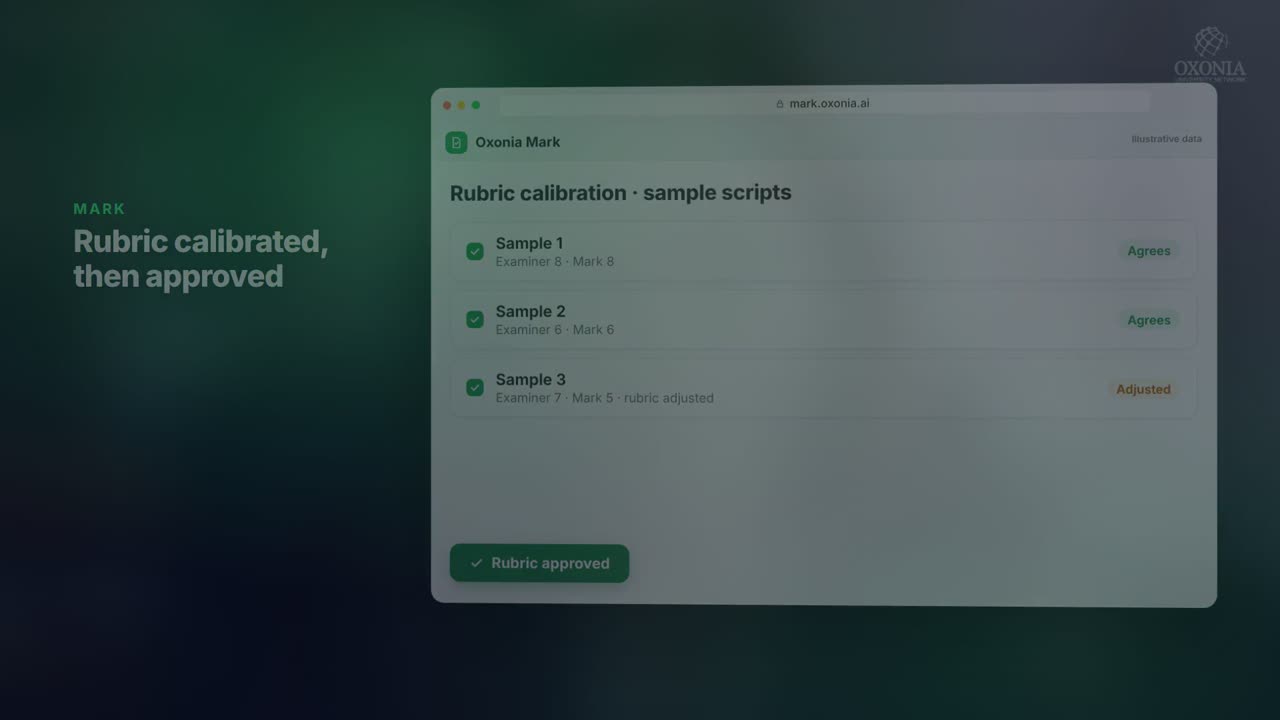
Examiners can adjust the rubric after a first look at the answers, for example to accept an alternative method that several students used. Mark then applies the updated rubric to every script, so early and late scripts are treated the same way.
Only the hard scripts go to a person first
Most answers are clear. Some are not. Mark sends four kinds of script to a person for direct review: uncertain marks, illegible handwriting, borderline grades and scripts flagged for academic integrity concerns.
This puts examiner time where it matters. Instead of reading every script at the same depth, an examiner checks the evidence on routine scripts and spends real thought on the difficult ones. A named examiner still approves every script before results are released.
The same logic supports fairness. Borderline cases get a closer look, not a quicker one. Integrity flags go to a person, never straight to a penalty.
Moderation, appeals and the exam board
Mark keeps a full record of each mark, its evidence and who approved it. Moderators can sample scripts and compare markers. When a student appeals, staff can show exactly which words earned which marks, and can re-mark with the record in front of them.
Once marks are approved, Mark builds the results broadsheet and a results pack for Senate. That pack can go straight into a meeting in Senate. Item analysis shows which questions worked and which confused everyone, which helps when setting next year's paper.
Students see released results in Oxonia Learn, with per-question feedback and their marked script. They can request a re-mark from the same screen.
Staff time on appeals often falls sharply when the evidence is already there. Instead of finding the script, re-reading it cold and reconstructing the original reasoning, the reviewer starts from the quoted words, the rubric and the approving examiner's name.
Using the Library and past papers
Mark University plans include Library at no extra cost. Library holds past papers, theses and journals from your own university. Examiners can check how a question was set and marked before. Students can revise from real past papers with cited answers.
For larger exam seasons, our guide to exam marking at scale walks through planning, scanning and moderation across a whole faculty.
Lecturers can also link exam outcomes back to teaching. If item analysis shows a weak topic, they can see whether the same topic caused trouble in Scribe quizzes or Tutor sessions earlier in the term.
Keeping marking fair and accountable
Universities rightly ask hard questions about any tool that touches grades. Mark is built around a few firm rules. Marks are drafts until a person adopts them. Every mark quotes its evidence. Uncertain cases go to people, not to a default. A named examiner signs off every script.
These rules matter for students and for regulators. A student can see why they lost marks on a question. An external examiner can sample the record. A quality office can show that each grade was approved by a named member of staff. The record supports accreditation and regulator returns as well as appeals.
Integrity flags need special care. Mark raises a flag when an answer needs a closer look. It never decides misconduct. A person reviews the script and the university's normal procedure applies. This keeps the process fair and keeps the decision with the academic staff who are responsible for it.
Mark also respects the university's own settings. Each university chooses whether to use the shared AI credit wallet or its own AI keys, and sets who can see which scripts by role.
Prices and how to start
Mark costs £15,000 a year for up to 5,000 students, £23,000 for 5,000 to 15,000 and £34,000 for 15,000 to 40,000. A department can use the Department plan at £3,100 a year. You can also pay as you go at £0.12 per script.
Mark is part of Oxonia Teach, and its exams-office tools come with Oxonia Operate. Start with one department and one exam if you prefer, then see pricing.
| Option | Price | Best for |
|---|---|---|
| Pay as you go | £0.12 per script | Trying one exam or a small cohort |
| Department plan | £3,100 a year | One department's exams |
| Up to 5,000 students | £15,000 a year | Whole university |
| 5,000 to 15,000 students | £23,000 a year | Whole university |
| 15,000 to 40,000 students | £34,000 a year | Whole university |
Products in this article
Questions people ask
Can Mark read handwritten exam scripts?
Yes. Mark marks handwritten and online exams to your rubric. Illegible scripts are sent to a person to review.
Does a human approve the marks?
Yes. A named examiner approves every script. Uncertain, illegible, borderline and integrity-flagged scripts go to a person first.
How much does Mark cost per script?
Pay as you go costs £0.12 per script. Yearly plans start at £3,100 for a department and £15,000 for a university with up to 5,000 students.
Does Mark help with appeals?
Yes. Each mark quotes the words that earned it, so staff can explain a mark and re-mark with the full record.
Leaflets


More videos
 0:50Conference film · Chapter 7Learn: Mark
 1:39Suite filmOxonia Teach in 100 seconds
 1:19Conference film · Chapter 6Teach: Scribe and Tutor
Keep reading
Related articles
Oxonia Teach →
For professors, lecturers, tutors and course leaders: the syllabus drafted week by week, every lecture captured live in its own language, assessment that explains every mark under the university's AI-use policy, and progress monitoring that shows who needs support.