Research for research offices
Research Office Software for Grants, Ethics and PhDs
Research offices run on email chains and spreadsheets. Research gives funding, ethics, projects and PhD supervision one shared record.
Why research offices struggle
A research office supports every stage of the research cycle. It spots funding calls, helps staff write bids, gets internal approval, manages ethics review, tracks budgets and reports outputs. In many universities, each stage lives in a different spreadsheet or inbox.
The result is familiar. Good calls are missed because nobody saw them in time. Bids are submitted without the right sign-off. Ethics applications wait in a queue nobody can see. Doctoral students go months without a recorded supervision meeting. At the end of the year, someone builds the research report by hand.
Research is the newest product in Oxonia Discover. It brings these stages into one place, linked to the people and departments already in the platform.
The aim is not to add another system for researchers to feed. It is to replace the spreadsheets and email chains with one place that everyone already reaches through their Oxonia Academy ID. Researchers spend less time on forms and more on research. The research office spends less time chasing and more time helping people win bids.
Funding calls matched to staff
Research collects funding calls and matches them to staff based on their research interests and past work. Each researcher sees the calls most relevant to them. Research office staff see who has been sent what, and can follow up.
Matching is Ai enabled, and it explains why a call was suggested. A researcher can see that a call matched their recent publications on a topic, and decide quickly whether it is worth pursuing. The research office can also push a call to a whole department.
This turns call-spotting from a weekly email that everyone ignores into a short, relevant list for each person.
Researchers can tune their interests at any time. A new lecturer can add their topics on day one and start receiving matched calls straight away. The research office can also see which areas attract many calls and few bids, which helps it decide where to offer bid-writing support or internal seed funding.
Grant bids with an internal approval chain
When a researcher decides to bid, they start the bid in Research. The bid follows the university's internal approval chain. That might include the head of department, the faculty research lead, finance and the research office. Each person approves or returns the bid with comments.
Everyone can see where a bid sits and what is still needed. Deadlines are visible. Approvals are recorded with names and dates. Nobody has to chase signatures by email the night before submission.
- Bid record with budget, partners and deadline
- Approval chain set by the university
- Comments and returns recorded at each step
- Clear view of all live bids for the research office
Research ethics applications and decisions
Researchers submit ethics applications through Research. The ethics committee reviews them, requests changes and records its decisions. Applicants can track progress without emailing the committee secretary.
Committee meetings can run through Senate, which handles agendas, papers and minutes for any committee. Decisions are recorded against each application. When a project starts, its ethics approval is already attached.
Ethics committees can set their own forms and review routes. Low-risk applications can follow a shorter path, while higher-risk work goes to the full committee. Each route is recorded, so the university can show regulators and funders how ethics review works in practice.
Projects, budgets and PhD supervision
Funded bids become projects with budgets. Project leads and finance staff can see spending against the plan. The research office sees all active projects in one list.
Doctoral supervision has its own space. Supervisors and students log supervision meetings, agree actions and record progress reviews. The graduate school can see who is on track and who has not had a recorded meeting for a while. This helps students who might otherwise drift, and gives the university a clear record if questions arise later.
Doctoral students can search earlier theses in Library, including digitised typed and handwritten work from the university's own collection.
Progress reviews follow the university's own schedule, for example at the end of each year of study. The record shows the student's progress, the panel's view and any actions agreed. If a student changes supervisor, the full history moves with them.
Publications, open access and the research dashboard
Research records publications and links them to ORCID, so a researcher's outputs stay in step with their profile. The research office can track open access status and see which outputs still need action.
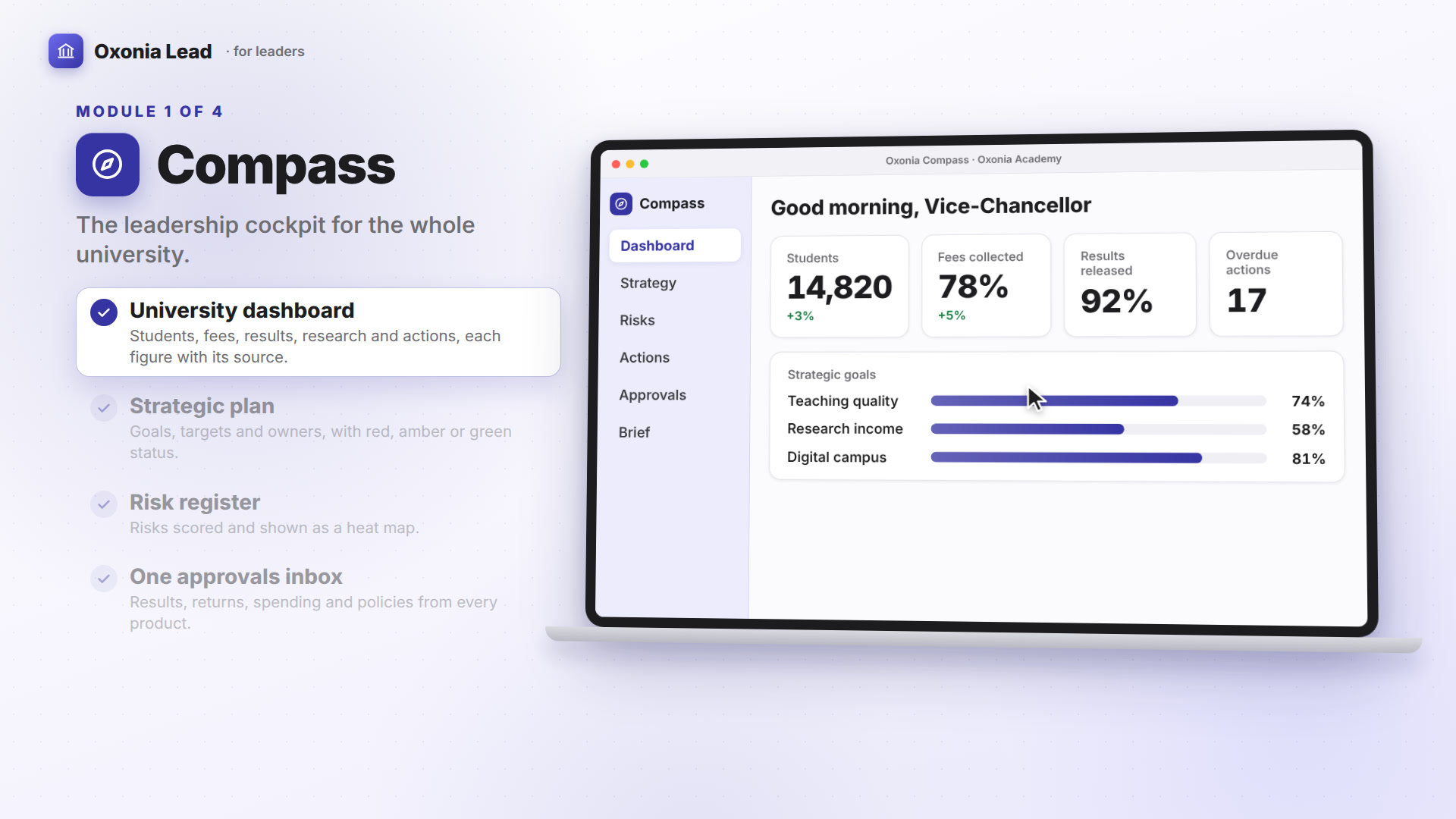
The research dashboard pulls this together: calls, bids, approvals, ethics decisions, active projects, supervision and publications. Leaders who also use Compass see research figures alongside the rest of the university, linked to strategic goals. Staff records in Nexus can draw on the same publication data for accreditation.
Researchers can also use the dashboard for themselves. They see their bids, their projects, their ethics approvals and their outputs in one view. That makes annual reviews and promotion applications much easier to prepare.
Prices and how to start
Research costs £10,000 a year for up to 5,000 students, £16,000 for 5,000 to 15,000 and £24,000 for 15,000 to 40,000. A department or research institute can start on the Department plan at £5,000 a year.
Research and Library together make up Oxonia Discover. The Discover package costs £20,000 a year for a university with 5,000 to 15,000 students. Research also has a Department plan at £5,000 a year. See pricing.
A good first step runs one faculty's bids and ethics applications through Research for a term, then compares the experience with the old process.
| Plan | Yearly price |
|---|---|
| Department | £5,000 |
| Up to 5,000 students | £10,000 |
| 5,000 to 15,000 students | £16,000 |
| 15,000 to 40,000 students | £24,000 |
| Over 40,000 students | By quote |
Products in this article
Questions people ask
Can Research match funding calls to researchers?
Yes. Research matches funding calls to staff based on their interests and past work, and explains each match.
Does Research handle ethics applications?
Yes. Researchers submit ethics applications, and the committee records its requests and decisions in Research.
Does Research link to ORCID?
Yes. Publications are recorded with ORCID and open access status.
How much does Research cost?
Research costs £10,000 a year for up to 5,000 students. A Department plan costs £5,000 a year.
Leaflets


More videos
 1:34Conference film · Chapter 10Your questions answered
 1:40Suite filmOxonia Lead in 100 seconds
 0:56Conference film · Chapter 8Discover: Research and Nexus
Keep reading