Exams office guide
How to Mark Thousands of Exam Scripts Without Burnout
Exam season does not have to mean weeks of late nights. Here is a step-by-step plan for marking at scale while keeping examiners in control.
The real cost of exam season
In many universities, exam season stops everything else. Lecturers mark for weeks. Exams officers chase missing marks and rebuild spreadsheets. External examiners receive packs late. Students wait, and some make choices about resits or fees without knowing their results.
The pressure also affects quality. Markers get tired. Consistency drops. Totals get added wrong. When a student appeals, staff struggle to explain a mark given weeks earlier.
None of this comes from a lack of care. It comes from a process built on paper and spreadsheets. This guide shows how an exams office can run the same process with Mark, without removing the people who must make the decisions.
The steps below assume a faculty running several hundred to a few thousand scripts in one season. Smaller departments can follow the same pattern with fewer people. Larger universities simply run it in parallel, paper by paper.
Step 1: plan the rubric before the exam
Good marking starts with a clear rubric. Examiners should write it when they set the paper, not when the scripts arrive. Each question needs the points that earn marks and what a full answer looks like.
In Mark, the examiner enters or uploads the rubric for each question. The exams office checks that every paper has one before the exam date. This one step makes the rest faster, and it also makes moderation fairer.
- Write the rubric when the paper is set
- Agree it with the second marker in advance
- Note any acceptable alternative answers
- Check past papers in Library for how similar questions were marked
Step 2: scan and collect scripts
Handwritten scripts are scanned after the exam. Online answers come in directly. Both go into the same workflow. The exams office matches each script to a candidate number, so markers do not need to see names.
Plan scanning like any other logistics task. Book the scanners. Agree who collects scripts from each hall. Set a time by which every script must be uploaded.
Check scan quality early. A faint or skewed page is harder to read, for people and for Mark. Pages that cannot be read clearly are routed to a person as illegible, so they are never guessed at, but good scanning keeps that pile small. Keep paper scripts safely stored until the exam board has met and the appeal period has closed.
Step 3: first pass and routing
Mark applies the rubric to each answer and proposes a mark. Every mark quotes the words that earned it and has a confidence score. This first pass is Ai enabled, and it is only a draft.
Then Mark routes scripts. Four kinds go to a person for direct review: uncertain marks, illegible handwriting, borderline grades and integrity flags. The rest go to the examiner as checked drafts, with the evidence shown beside each mark.
Examiners work through the routed scripts first, while they are fresh. Then they review the rest. A named examiner approves every script. Nothing is released without that approval.
Step 4: moderation and external examiners
Moderators sample scripts across markers and grade bands. Because each mark has quoted evidence, a moderator can see quickly whether the rubric was applied the same way. Disagreements are recorded with reasons.
External examiners can review the same records. They see what was marked, why and who approved it. This makes their visit shorter and their report more useful. Item analysis shows which questions did not work, which helps the next paper.
Moderation also gets easier to plan. Instead of drawing a random sample by hand, moderators can choose scripts from each band, each marker and each routing reason. That gives a better picture with the same effort.
Roles and timing for a faculty
Large exam seasons work best when everyone knows their job and their deadline. A typical faculty plan looks like this.
- Six weeks before: examiners finalise papers and rubrics. The exams office checks every paper has a rubric.
- Exam week: invigilators collect scripts. The exams office scans and uploads each day's scripts the same day.
- Week one after: Mark completes the first pass. Examiners review routed scripts first.
- Week two after: examiners approve all scripts. Moderators sample. External examiners review.
- Week three after: the exams office builds the broadsheet and Senate results pack for the exam board.
Keep a simple dashboard of progress by paper. If one paper falls behind, move help to it early. Task reminders in Office can chase late steps so the exams officer does not have to.
After the board, hold a short review. Look at item analysis for each paper. Note which rubrics caused disagreement in moderation. Fix them before next year. Each season then runs a little smoother than the last.
Step 5: exam board, release and appeals
When marks are approved, Mark builds the results broadsheet and a Senate results pack. The pack can go into the exam board or Senate meeting in Senate, where the decision is minuted and recorded.
Students then see released results in Oxonia Learn, with per-question feedback and their marked script. Re-mark requests come in through the same screen. Staff handle them with the full record, so an appeal becomes a check rather than a hunt.
Want to try this on one exam first? Mark pay as you go costs £0.12 per script. A Department plan costs £3,100 a year. See pricing or Oxonia Teach.
| Stage | Who | Done in Mark |
|---|---|---|
| Rubric entered | Examiner | Yes |
| Scripts scanned or collected | Exams office | Yes |
| First pass and routing | Mark, as a draft | Yes |
| Routed scripts reviewed | Examiner | Yes |
| Every script approved | Named examiner | Yes |
| Moderation and external review | Moderator, external examiner | Yes |
| Broadsheet and Senate pack | Exams office | Yes |
Products in this article
Questions people ask
How can a university mark exams faster?
Set rubrics early, scan scripts promptly and use a first pass that proposes marks with evidence, so examiners focus on the scripts that need judgement.
Which scripts does Mark send to a person?
Uncertain, illegible, borderline and integrity-flagged scripts go to a person first. A named examiner still approves every script.
Can external examiners see the marking evidence?
Yes. Each mark quotes the words that earned it, with a record of who approved it.
Leaflets


More videos
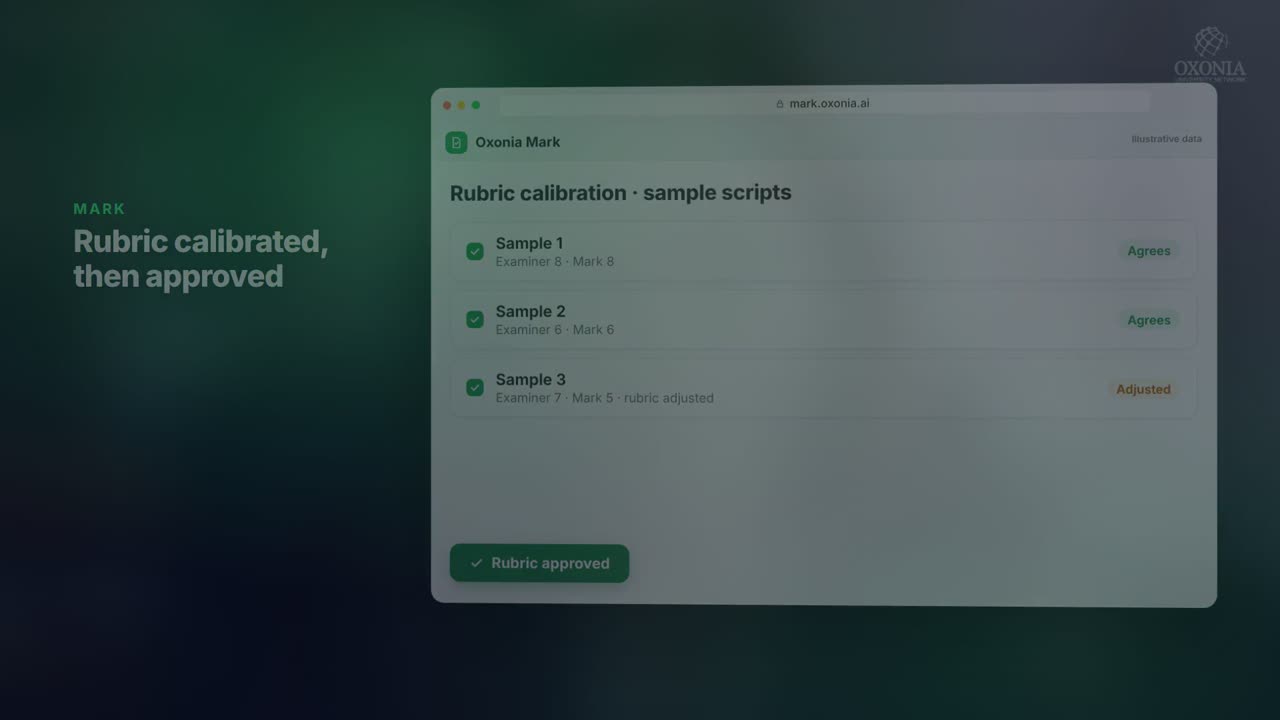 0:50Conference film · Chapter 7Learn: Mark
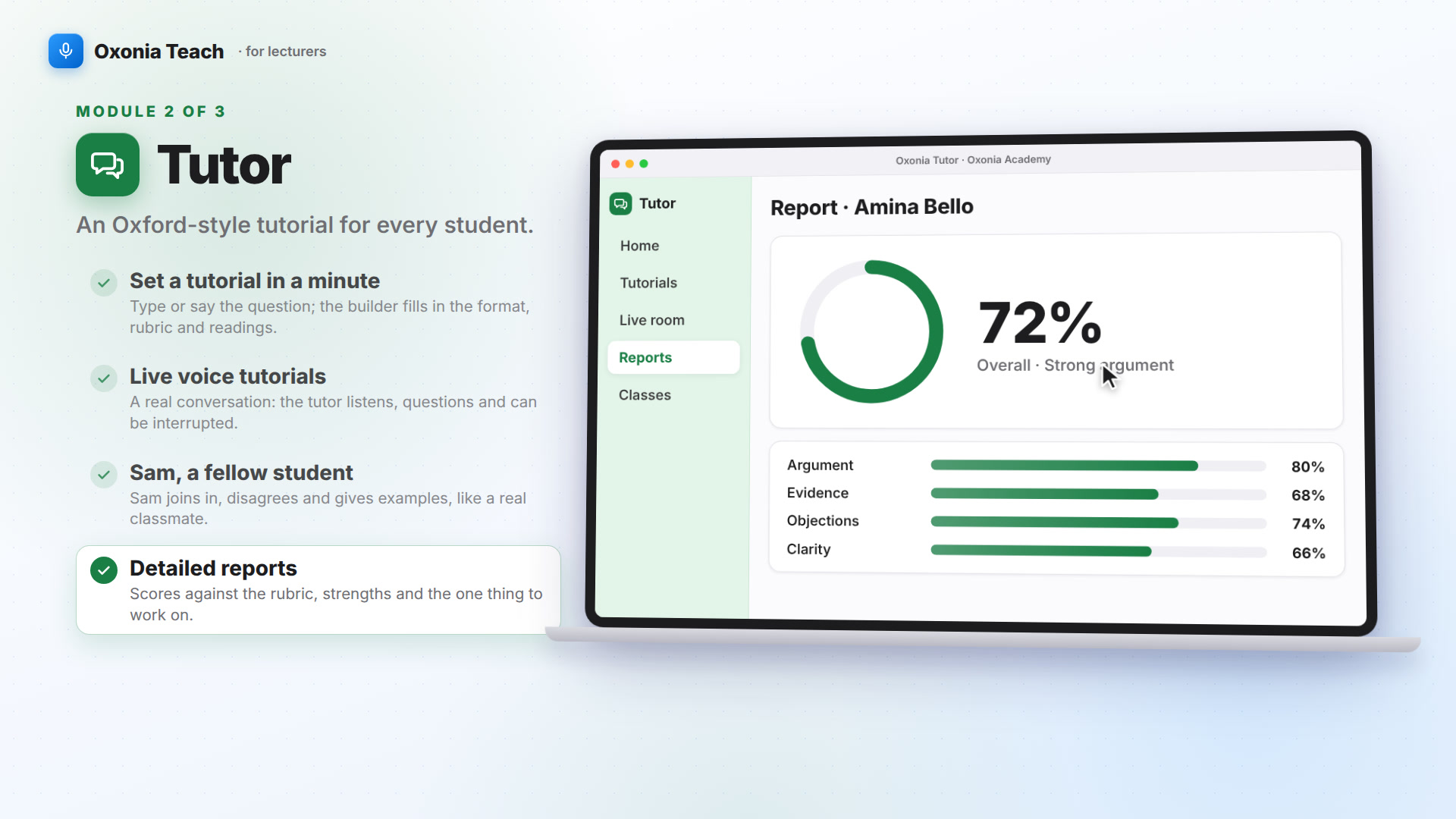 1:39Suite filmOxonia Teach in 100 seconds
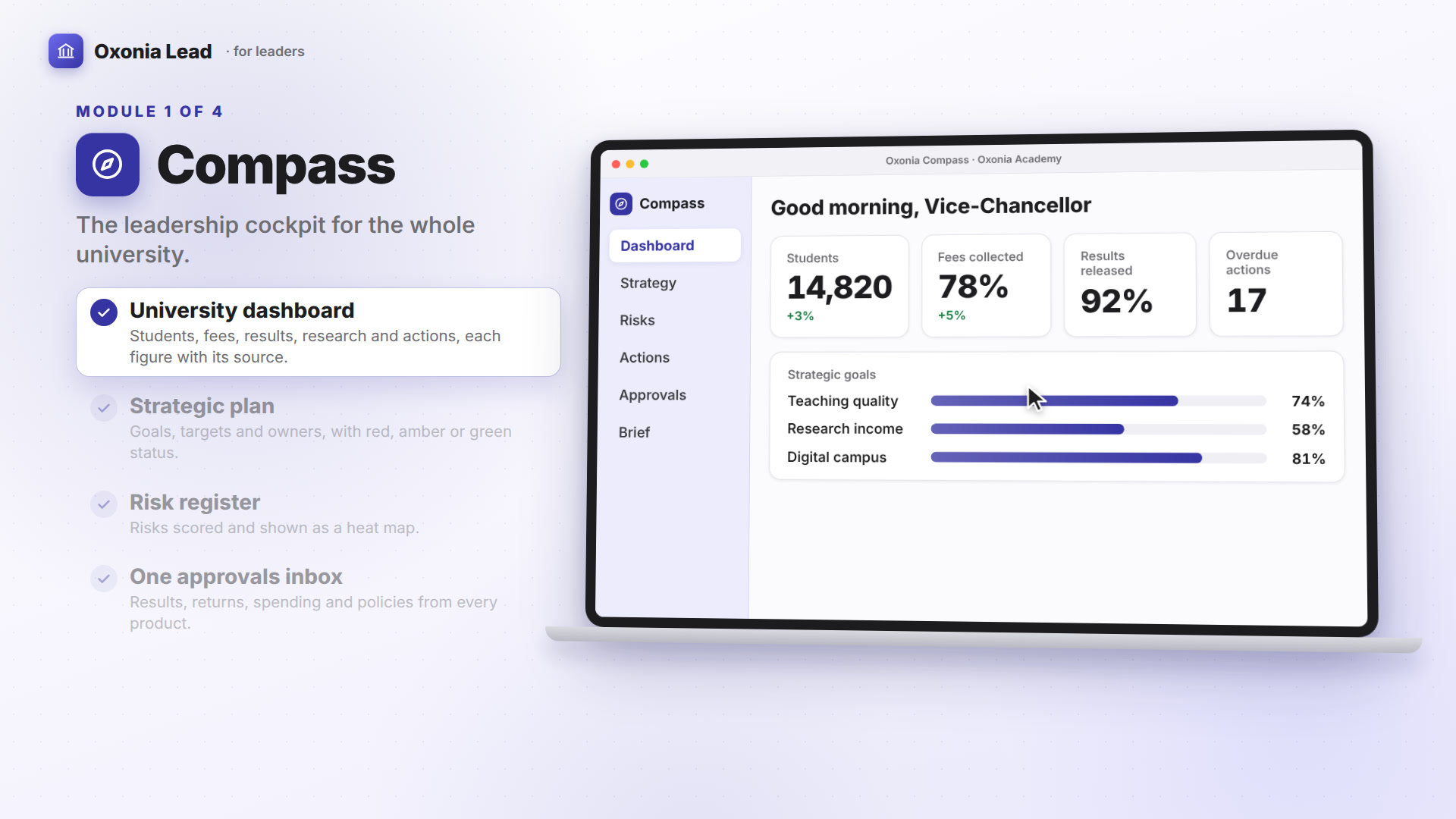 1:40Suite filmOxonia Lead in 100 seconds
Keep reading
Related articles
Oxonia Teach →
For professors, lecturers, tutors and course leaders: the syllabus drafted week by week, every lecture captured live in its own language, assessment that explains every mark under the university's AI-use policy, and progress monitoring that shows who needs support.