Regional guide
Building a Digital University in Nigeria and Across Africa
Going digital in an African university means working with real conditions: phones over laptops, handwritten scripts, local payments and tight budgets.
Digital on local terms
Many digital tools for universities were designed elsewhere, for conditions that do not match those in much of Africa. They assume every student has a laptop, that exams are typed, that fees are paid by card and that budgets match those of large wealthy institutions.
African universities face different conditions. Most students use phones. Many exams are handwritten. Families pay fees by bank transfer, often in instalments. Sponsors, scholarship schemes and guardians play a large role. Budgets are tight, and the cost of a tool must be justified in local currency.
Oxonia Academy is built to work in these conditions. This guide looks at the areas where that matters most and shows how each Oxonia product fits.
The aim is not to copy a model from somewhere else. It is to build a digital university that works for your students, staff and leaders as they are.
Pricing and payment that fit
Universities in Nigeria pay 35% of the UK price, billed in naira. That puts the platform within reach of public and private universities and avoids exposure to currency swings during a contract.
Payment is flexible too. Universities can pay by card, Paystack, bank transfer or invoice and purchase order. The same options are open to students and families through Wallet, where they can see fee balances, join payment plans, pay and download receipts on a phone.
Department plans let a single department start at a lower price. See the pricing guide for the full set of options.
Billing in naira also helps with budgeting and procurement. Finance teams can plan for a known local cost, and invoices and purchase orders follow the university's normal process. Three-year contracts take a further 10% off, which helps universities plan ahead with confidence.
Phone first, for students and staff
Every Oxonia product works through the Oxonia Academy ID on a phone. Students can follow live captions in lectures, review summaries and quizzes, take a tutorial, check results and pay fees from the same app.
Governance works on phones too. Council members read board packs in the Boardroom app, and Action Chaser in Senate sends reminders by email and WhatsApp, where many staff already spend their day. Action owners can update progress straight from the message.
- Study tools, tutorials and results on a phone
- Fees, payment plans and receipts on a phone
- Board packs in the Boardroom app
- Action reminders by email and WhatsApp
Phone-first design also helps where connections are slow or expensive. Students can download study packs and audio recaps when they have a good connection and use them later. Lecturers can check class insights between lectures without a desktop computer.
Handwritten exams and theses
Handwritten exams remain the norm in many universities. Mark marks handwritten and online exams to a rubric. Each mark quotes the words that earned it, with a confidence score. Uncertain, illegible, borderline and integrity-flagged scripts go to a person first, and a named examiner approves every script.
Mark can be bought pay as you go at £0.12 per script, which suits a single faculty trying it on one exam. Results reach students in the app, with per-question feedback.
Many universities also hold decades of typed and handwritten theses that have never been digitised. Library digitises them, with a correction editor, and answers questions from them with citations. Local research on local problems becomes visible again. Library is free with Mark University plans.
Item analysis helps departments improve exams over time, and the results broadsheet and Senate results pack save the exams office weeks of manual work each season. Appeals become easier to handle because every mark carries its evidence.
| Condition | Oxonia approach |
|---|---|
| Most students use phones | Every product works on a phone with one login |
| Fees paid by transfer and in instalments | Paystack, transfer, payment plans in Wallet |
| Handwritten exams | Mark marks handwritten scripts, examiner approves each |
| Undigitised theses | Library digitises typed and handwritten theses |
| Staff rely on WhatsApp | Action Chaser reminders by WhatsApp and email |
| Budgets in naira | Nigeria pays 35% of UK price, billed in naira |
Languages across the continent
Most Oxonia interfaces are available in English, French, Portuguese and Arabic, and many also in Hausa, Yoruba, Igbo and Nigerian Pidgin. Oxonia Nexus is in English for now. That covers anglophone, francophone and lusophone universities and those in North Africa.
In lectures, live captions in Scribe can be switched into each student's own language. Many students speak Hausa, Yoruba, Swahili or another language at home and study in English or French. Check the languages your students need when you book a demo. Read more in teaching in students' own languages.
Universities that teach in French, such as those across West and Central Africa, can run every product except Nexus in French. Universities in Portuguese-speaking countries can do the same in Portuguese. Arabic includes right-to-left layout.
Governance, regulators and AI
Regulators across the continent expect accurate returns and well-run governance. Nexus keeps verified staff records, tracks accreditation readiness and fills regulator returns for the vice-chancellor to sign. Senate keeps decisions, minutes and actions in order.
AI is arriving in African universities as fast as anywhere else. Policy helps the university write an AI policy, approve it through Senate, train staff and record which tools are in use. Students learn the rules through AI Hub.
Fees are also a major cause of students leaving. Read keeping students who might leave over fees for a practical approach.
Where to start
Most African universities start where the pain is greatest. Often that is exam marking, fee collection or governance paperwork. Starting with a single department shows results in one term.
From there, the platform grows suite by suite on the same Oxonia Academy ID. See Oxonia Lead, Oxonia Operate, Oxonia Teach, or pricing.
Plan for people as well as technology. Name a senior sponsor, involve heads of department early and give staff a short introduction before each product goes live. A roll-out that staff help to shape is far more likely to spread across the university.
Products in this article
Questions people ask
How much does Oxonia cost in Nigeria?
Universities in Nigeria pay 35% of the UK price, billed in naira.
Can students pay fees with Paystack?
Yes. Wallet supports Paystack, card, bank transfer and invoice.
Can Oxonia mark handwritten exams?
Yes. Mark marks handwritten and online exams to a rubric, and a named examiner approves every script.
Which languages does Oxonia support?
Every product except Oxonia Nexus, which is in English for now, can be used in English, French, Portuguese and Arabic, and many also in Hausa, Yoruba, Igbo and more. Lecture captions can be switched into many languages, including Hausa, Yoruba, Igbo, Arabic, French and Swahili.
Leaflets


More videos
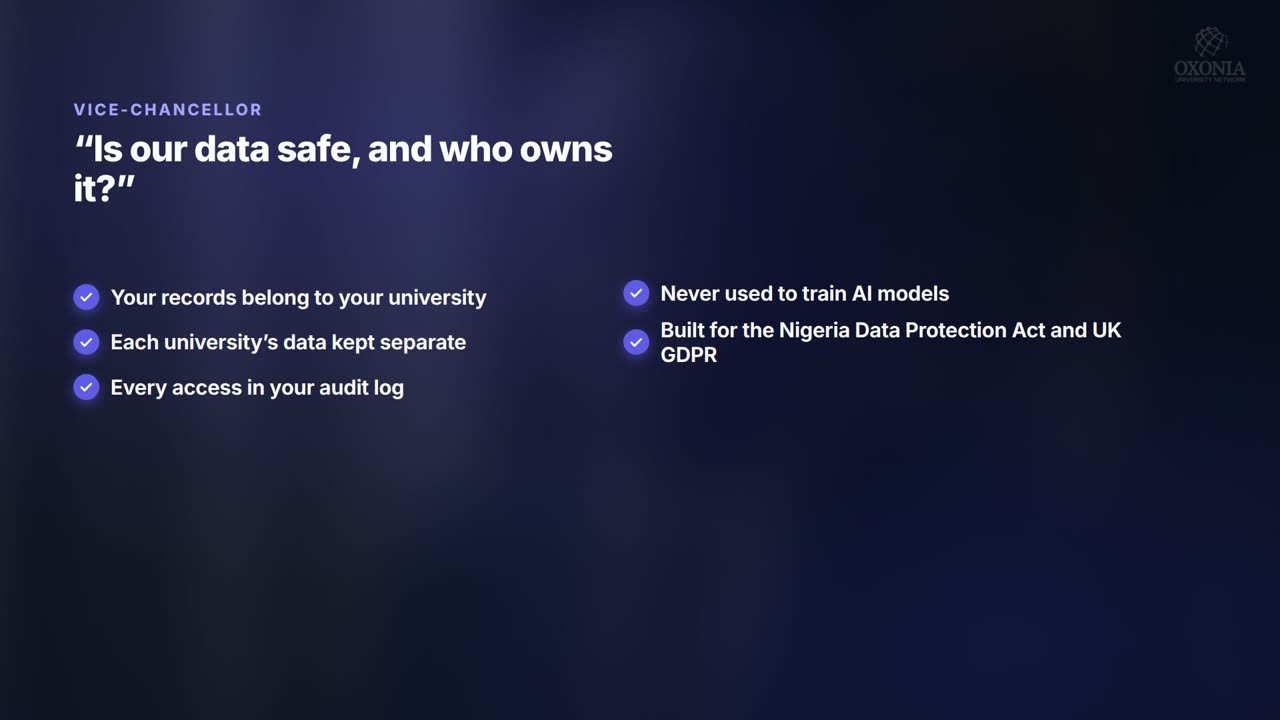 1:34Conference film · Chapter 10Your questions answered
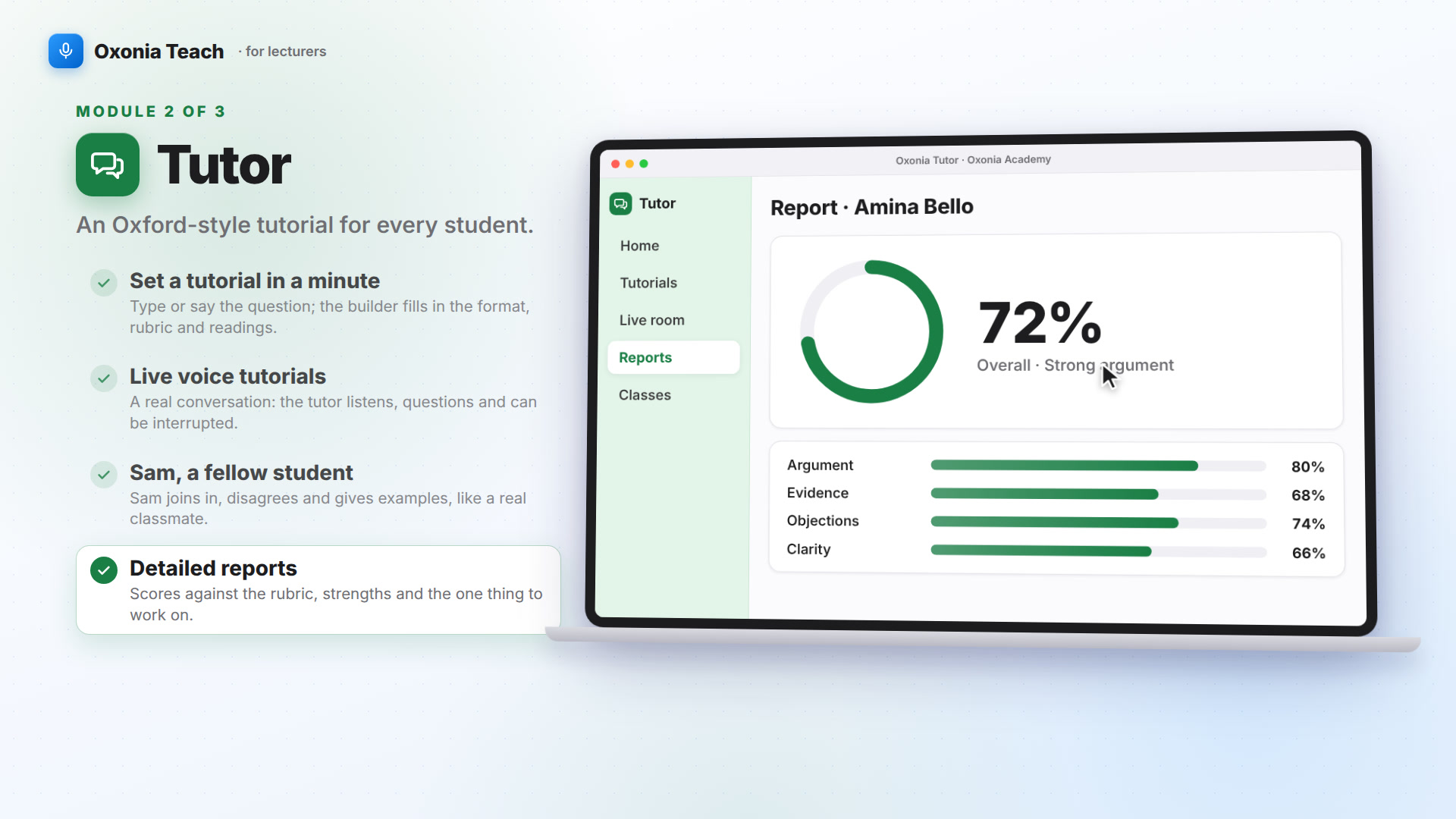 1:39Suite filmOxonia Teach in 100 seconds
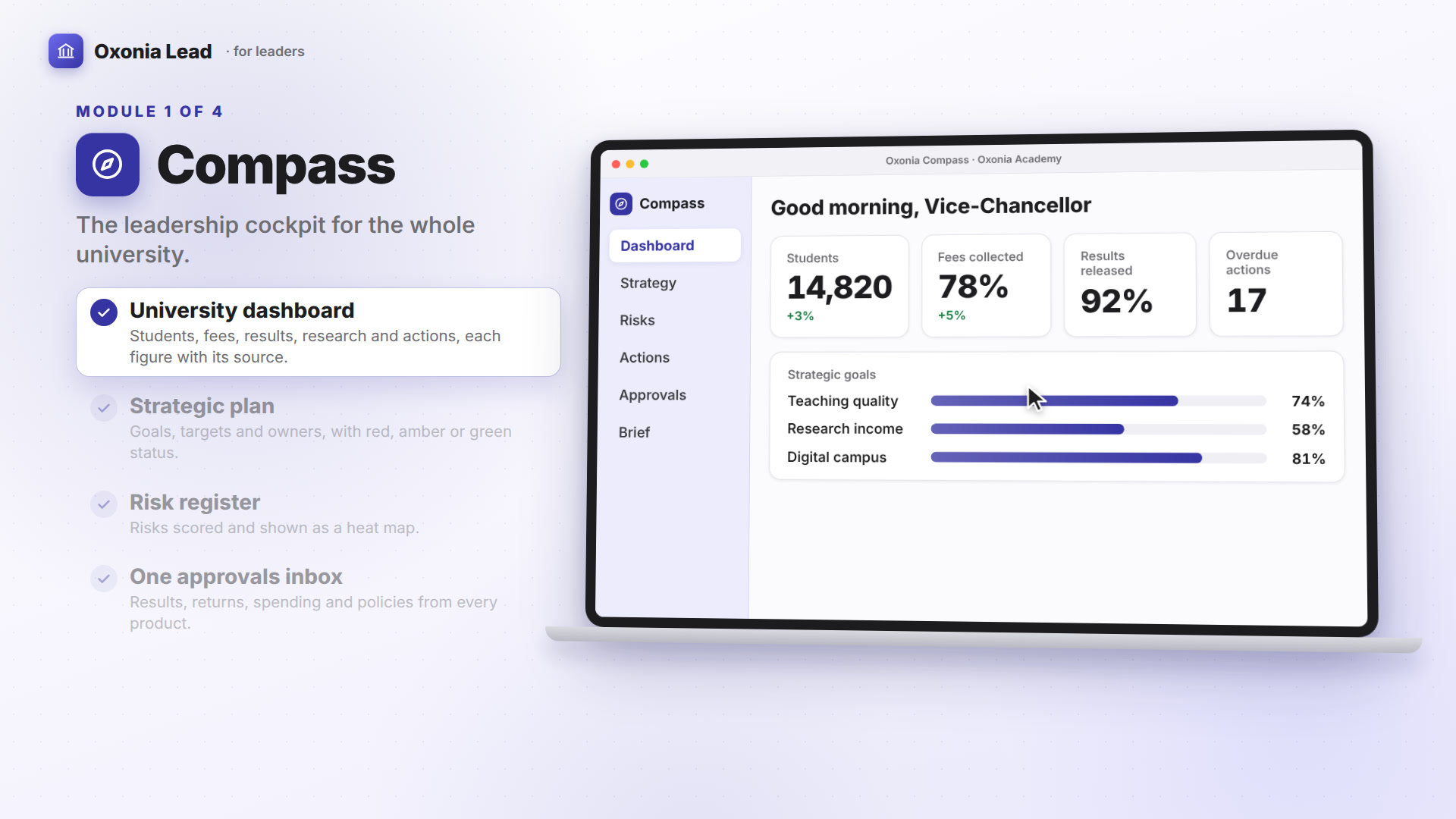 1:40Suite filmOxonia Lead in 100 seconds
Keep reading